It all started a few years back, with a mother, her daughter and simple conversations. The daughter was a second generation Australian and the mother, a first generation migrant. The two would sit together and talk endlessly, an activity they both cherished. And though sometimes things used to get lost in translation, with love and patience, the duo would often find common ground to build on.
As a primary school child, one of the initial questions the daughter would ask the mother was: “Mum, why do many people in the South Asian community value math and science over arts and music?”
To this, her Amma, replied: “Because that’s how generationally we’ve been raised. We’ve been raised to think academics are more important than creativity.”
The daughter listened, then sighed. While she appreciated her mother’s honesty, she wasn’t satisfied with the answer. But life moved on and their relationship evolved.
A few years later, as a high school student, the daughter had another question: “Mum, why do parents in South Asian communities compare their kids to other kids?”
This time, the mother retorted with the answer: “Most parents do it with a good intention and as a means of motivating them. A way to say if that child can do it then you most definitely can.”
The daughter wondered if there was a better way to do this.
And as years and conversations went by, the daughter kept asking questions and realised that her questions would lead to more pondering and contemplations. Questions like:
-
Why do we feel uncomfortable if I bring up menstruation?
-
Why do people notice what we look like on the outside as opposed to what we feel on the inside?
-
Why do people consider the results of an exam as the be-all and end-all?
Over the years, she noticed that while her parents would readily answer her questions, these weren’t the kind of conversations her peers were having within their families. She couldn’t help but wonder why.
As time went on, the daughter grew up to become a film student, passionate about telling diverse stories and the mum had transitioned to become a mental health professional and art therapist. As COVID hit, both of them had an opportunity to converse more, and the mother picked up on her daughter’s dissatisfaction that these honest and vulnerable conversations weren’t a reality for all.
Through this, both of them realised these problems need to be addressed and discussed openly, without the shackles of taboo. Given their creative commonalities, the two decided to establish a medium where such conversations could be had.
Her mother asked: “Why don’t we create a podcast? We could unpack topics that South Asian families consider taboo, and we will explore them through an intergenerational mother/daughter lens. Maybe that'll help?”
Hearing what her mum said, the daughter pondered. She thought of how the two often didn't see eye to eye and considered how difficult it would be to work together. But optimism dimmed these concerns and she agreed.
With their idea bubbling away, they started doing research, looking into logistics, equipment, software, and the biggest puzzle of them all, promotion. After all, they needed people to listen to the show.
As a Cusper, her mother wanted to challenge generational stereotypes, using social media as a form of communication. However, the daughter defied another stereotype of her generation and was not a fan of the idea, giving the podcast a rocky start. And that was just the beginning. They quickly realised the differences in schedules, working styles, ideologies. They also had to navigate the boundary of maintaining a personal and professional relationship. Even if they disagreed, they still had to be near each other. Despite this, or maybe because of it, the two always found a way to come back together and find a middle ground. After all, they mastered this act from years of endless conversations.
After weeks of hard work, promotions, and a few tears here and there, the mother and daughter were ready to bring their idea into the world. Through this journey, they realised something that transformed their relationship. The two discovered that while they came from different generations and navigated vastly different worlds, they had more in common than they thought. And so that’s how Mindkshetra Talks: Lost in Translation came to be.
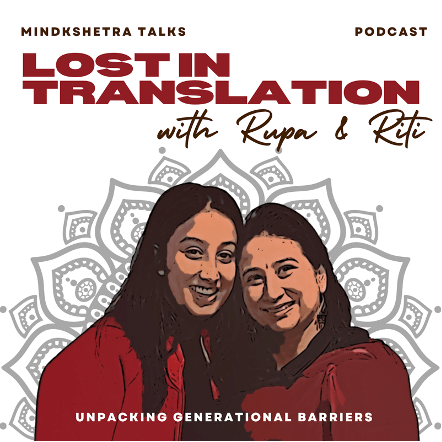
I'm Riti, and this is the story of a podcast I've co-created with my mum, Rupa with the hope to bridge our differences, and through the podcast, I want to extend that invitation to others. We want it to be a platform of entertainment and perspective for those experiencing similar disconnects and a desire to bridge the gaps. A place communities can break free from the word taboo and real conversations can be hosted. A space where we work together to unpack generational barriers. After all, we don’t want things to get Lost in Translation.
You can listen to Lost in Translation on Youtube and Spotify. Show your support!
Riti is a filmmaker and writer in Sydney. She currently studies at the Australian Film Television and Radio School and is passionate about the arts and creativity. You can connect with her via Linkedin or Instagram.