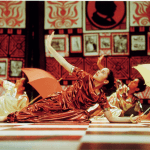
I had no idea there was a brown Spider-Man. But when I heard the telltale sounds of a tabla, followed by an orchestra of familiar Indian instruments playing in Spider-Man: Across the Spider-Verse, I was transported to every Indian wedding I’ve ever attended. I almost immediately wanted to break into the bhangra.
Sure enough, web slinging, gorgeous-haired Pavitr Prabhakar is introduced to the audience.
Pavitr’s introduction as Spider-Man in Earth-50101 comes perfectly timed in the film, as Gwen and Miles are fighting one of the villains of the second animated Spider-verse film, Spot.
Pavitr fights with a trademark gold bangle that could be found in any Indian street market. As soon as hits Spot, there’s a flash of Hindi script: TADAK!
It's a quick five second sequence, but it packs an immense amount of culture. As the introduction continues, I found Pavitr to be instantly likeable. He introduces himself proudly before showing off the town that he lives in: Mumbattan (a blend of Mumbai and New York’s Manhattan).
Obnoxiously, while watching this sequence of events, I turned to my friend and said in astonishment and excitement, “This is India!” as if I was the only one in the audience who may recognise such cultural calls.
I had to stop myself from leaning over and culture-splaining the jokes delivered from Pavitr: “See, it’s funny that Pavitr keeps pointing out the traffic in Mumbatten, because traffic is notoriously bad in India! If you can drive in India, you can probably drive anywhere!”
I bit my tongue during the entirety of Pavitr’s entrance instead.
I felt the excitement bubble further within me, as well as the unnecessary need to gate-keep Pavitr from any non-Indian audience. ‘He’s ours!’ I wanted to boast proudly when the audience laughed along at his jokes.
As the movie continued, I felt beyond proud with Pavitr’s representation. It wasn’t tokenistic, but enriching and complimentary to the overall film.
Pavitr is good at being Spider-Man.

While Miles feels inadequate and unsure about his Spider-Man abilities, Pavitr proudly boasts about how easy he finds being Spider-Man after only being Spider-Man for a mere six months. Pavitr is also able to easily maintain a relationship with his girlfriend, get good grades, not “work out too much” because he’s “naturally buff and doesn’t want to get too big”, and have effortlessly amazing hair that only requires “coconut oil, prayers and genetics.” (It instantly transports me back to childhood and the rigorous way my own mum would rub coconut oil into my hair.)
As an audience member, it was incredible to see an Indian character be unapologetically Indian, with an Indian accent, and not get laughed at but laughed with.
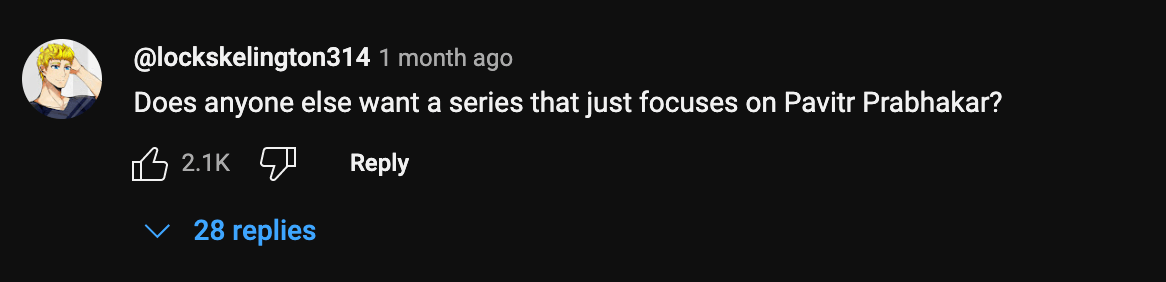
This is why it’s so important that Pavitr’s character is immediately likeable. The ‘Indian Spider-Man’ has already become a fan favourite, and not just for Indian audiences. I’ve never seen an Indian superhero with so much fanart on Twitter – the entire Pavitr Prabhakar tag on Twitter is filled! – or Indian cosplayers, let alone them dressing as their very own Indian Spider-Man. I’m gleefully surprised at Pavitr being called “the coolest” Spider-Man who “makes an instant impact as one of the best and funniest new additions to the sequel.” The character’s intro on YouTube is littered with comments of love and appreciation, like user MyVad3r who commented, ‘saw this in indian cinema theatre. thought he would be like a cameo.. but damn. whole theatre went nuts.’ I’m reading of audiences in India erupting into cheers, dancing and whistling because of a Spider-Man movie. I’ve even had friends linking me to Tweets about Indian martial arts and how it was used for inspiration to animate the film.
Everytime I google Pavitr, I find that an audience member has found another easter egg and clue as to how much detail went into creating him. It makes me incredibly proud to have my own rich culture showcased positively. In the purest way possible, it’s exciting to see. I feel like a child again, being able to hold onto a doll and say, “This is mine”.
Even more wonderfully, Pavitr gets the happy ending that no other Spider-Man is allowed.
As Spider-Man: Across the Spider-Verse continues, it’s explained that tragedy is part of the ‘canon’ in becoming Spider-Man. Loss is inevitable – even a necessity.
But Pavitr doesn’t receive this tragedy. He’s the only Spider-Man to get the best of both worlds – he gets to be Spider-Man and save a bus full of children, while his girlfriend Gayatri and her father survive too, despite the entire scene being displayed as an ultimatum for him to choose from. (Save the children as Spider-Man, or save your girlfriend and her father as Pavitr.)
It’s uncommon for characters of colour, let alone Indian characters, to have a happy ending. In Western media, the Indian characters get left behind or meet a tragic ending. Examples of this include Joe from Ginny and Georgia or Owen from Haunting of Bly Manor.
This happy ending for Pavitr is important and hopeful for the future of South Asian characters in mainstream media.
Pavitr’s voice actor, Karan Soni, spoke in an interview about how involved he was in the creation of Pavitr.
The Spider-Man: Across the Spider-Verse writers expressed their desire to include Karan in the process of bringing Pavitr to the screen.
“They were like, ‘Hey, we’re feeling like it’s not culturally specific enough. So, we’re gonna do a little writer’s room and we want you to come and just, like, pitch ideas.’ I grew up in India and I just know this character will mean so much to people from India… [the writers] were just so openly like, ‘Blow it up, what do you want to say?’”

Spider-Man: Across the Spider-Verse has reached critical success. It’s also been dubbed in ten South Asian languages.
Karan spoke about how he received messages from other Indians: “I cannot tell you how many messages I got from people. Firstly, they were just excited, and then there were a few more serious messages, saying mainly, ‘Don't mess this up.’ I don’t think we did!”
I’m just one Indian, but I can say wholeheartedly that Karan and everyone who put in work and effort into Spider-Man: Across the Spider-Verse has done an entire country and its diaspora proud.
Thank you for representing us positively and helping showcase what we can do, creatively.
Bio: Geetanjali Sharma is a 26 year old cis-female living on Ngunnawal country. She holds a Bachelor in Writing and often writes about culture and social issues. She’s also in the midst of writing her own first fictional novel.