Based on a true story, ‘For the Love of Paper’ is told by community, for community and follows two dear friends fighting for each other. But will the pressure of what they have committed to, threaten to break them apart?
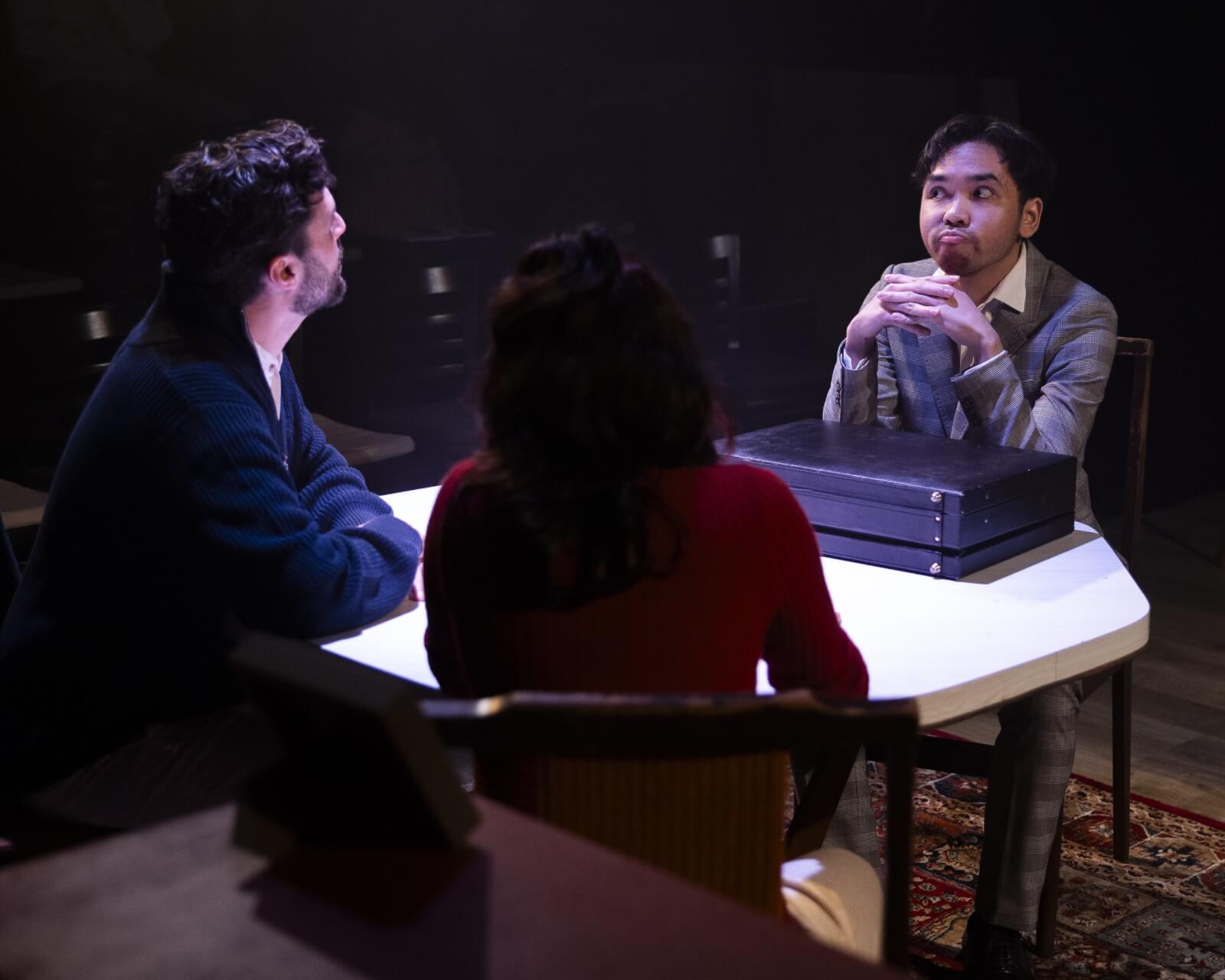
The play begins with best friends Amalia and Kaveh in a meeting with a glib immigration officer, running through Amalia’s options to stay in Australia. While it looks like Amalia’s doors are closing, the immigration officer coyly suggests that Amalia and Kaveh would look good together as a couple. Amalia replies,
“He bats for the other team.”

But the immigration officer implicitly suggests faking a de facto relationship. This sets off the events of our story and takes us on a journey of love in all of its beautiful and wonderful forms, dictated by the unforgiving and complex immigration laws of Australia.
The play teases out and articulates an experience a lot of people of colour face. When there is a clash between who we are and what our families and communities expect of us, we undergo a splitting of the self. It brings out the question - can we be our true selves at home? And is it home if you cannot be your true self?
We see this with Kaveh and the incessant phone calls from his mother guilt-tripping him to return home to marry a “beautiful Afghan bride.”
We see it with how he can be misunderstood in queer spaces in Sydney. When queried why he doesn’t just “come out” to his family, he exasperatedly has to explain that it could cost him his life if he were to return home and be found out. We see it again in his frustration of having done everything right by his family by becoming a doctor, getting an Australian passport and it still not being enough for them.
With Amalia this tension is evident with her relationship with her hometown of Karachi. It asks the question: can she be safe as a woman and as a religious minority? This is brought out when she despairs that “the opportunities we have are dictated by the places of our birth.” But it doesn’t mean she loves her home any less. We get to see a snippet of Almitra Mavalvala’s incredible vocals as she sings a ballad to Karachi. But the haunting words of her mother ring out to the audience, “There is nothing for you here.”

From the outset we learn that Amalia is strongly principled - never giving up her artistry for a 9-5 grind, even for the prospect of corporate sponsorship. She also does not pursue the option of seeking a protection visa, despite meeting the criteria.
As the stakes get higher, her discomfort with faking a de facto relationship, becomes palpable. While Kaveh undoubtedly loves her and wants her to stay in Australia, you begin to wonder whether there is more to this than wanting to help a friend.

Kersheka Sivukamaran in her directorial debut combined with the writing of Mavalvala ensures the honest and authentic telling of this story.
Every part of the play felt like it was told by one of us, rather than from an onlooker wanting to add an ‘edge’ to their script.
Under her direction, Almitra Mavalvala and Antony Makhlouf embody these characters effortlessly. Everything from their quick witted quips to a breaking point of their friendship, feels undoubtedly real.

At the final applause, I was jolted back to reality as I was reminded that I was watching a play and not two real friends. Along with Mavalvala and Makhlouf, Joseph Raboy excels in taking on the challenge of portraying a series of different characters, adding great comedic variety to the show.
Stand out scenes are the series of familiar and disappointing dates from crypto bros to leather daddies alike.
The play primarily takes place in Kaveh and Amalia’s apartment. The lighting design adds character and depth to the space and speaks to the inner journey of the characters. It also serves to transform and broaden the space when were are taken to places outside of Kaveh and Amalia’s apartment.
The set design creates a cosy and intimate atmosphere, allowing us as the audience to feel like we are almost a part of all the action, especially as you are able to walk through the set before and after the show where you can appreciate the personal touches.
For instance, a real Pakistani passport of Mavalvala’s is used on set. Behind the couch, a giant form for a supporting statement for a partner visa application looks on over their apartment, never failing to remind the audience what exactly dictates their future.

At its best, story telling is an articulation of experience. It is reaching out into nothingness and hoping even one person reaches back. Watching ‘For the Love of Paper,’ I felt myself and the entire audience reaching back - in laughter, in stillness and in applause.
For the Love of Paper is a compelling 90-minute theatrical creation. It is running from 5 April to 20 April at the KXT on Broadway in Ultimo, Sydney.
You can get your tickets here.
Amani Mahmoud is a solicitor and writer based in Sydney.