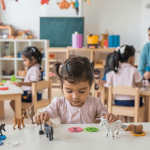
Not every child is a genius…or needs to be one
We all want the best for our children, but being open minded about their abilities might be better than assuming they’re our young prodigy.

Photo credit: Canva
Are our children really as smart as we think they are? Do we really know their abilities or do we imagine them to be more intelligent, perceptive or gifted than they may actually be?
I’ve pondered these questions for a while now, possibly since my sons were in Year 5 and I was incessantly asked by parents in my South Asian community if I intended putting them into special tutoring so they could get ready for the selective school exams.
“Nah!” was my usual answer, but after being confronted by expectant, indignant or somewhat hurt reactions at our casual parenting, I felt guilty enough to do a bit of research about selective schools, but in a half-hearted kind of way.
Make them succeed
My children were reasonably good at school, I reasoned, did they really need the additional push that would elevate them to a higher academic level than their peers?
“Yes!” Was a good friend’s emphatic response. “You have to give them the chance to excel because most ‘goras’ (‘white people’ in desi slang and a word I intensely dislike!) don’t care about their children’s opportunities. They’re happy if they finish Year 10 and become tradies,” he said with a touch of scorn. “Now, we value education so you must give them the best chance possible, you must make them excel.”
Excel at what?, I thought at the time. I was always an average student, but raised in a family that was loving, caring and at best, casual about academic prowess. I think I did more than okay, at university and in my career.
So I asked another acquaintance whose child was in the same year as my son.
“Of course,” she said, giving me a pitying look. “My son goes to special classes on Saturday and Sunday for four hours and he spends two hours every day after school studying for the exams that will get him into a selective school. There’s no discussion, he knows that he HAS to work hard and get a good mark!”
“That’s a lot of pressure on a young kid,” I timidly ventured to say.
“Yes, of course. But it’s for his own good. We came to Australia to give our kids better opportunities. It’s his duty to succeed!” was her reply.
I thought about that and instantly decided, “Yeah, nah!”
No geniuses in the family
My husband and I agreed that our kids didn’t need that kind of pressure. They would be miserable and stressed, disinterested and unable to fathom our adult reasoning of this being ‘for their own good’.
And most importantly, we didn’t want them to be unhappy.
We wanted them to enjoy their childhood and if spending time running around on the soccer field or playing imaginative games with their friends did that for them - well, so be it.
We believed that in time they would discover their natural ability, just like we did, and do what they were good at and what they enjoyed.
They were good students, but showed no signs of being geniuses. They excelled at subjects they were interested in, and were extremely average at ones they didn’t particularly care for.
So they did no tests or extra tutoring and cheerfully segued into secondary school. Now, this was a revelation of sorts!
Secondary School: A different ballgame
Like many first generation immigrants, I’ve realised that primary school teaching here can be pretty deceptive in presentation, as kids pretty much learn at their own pace and have very few tests or exams.
This leads us, first generation immigrant parents, to assume that the whole schooling experience up to Year 12 will be a breeze, because the primary curriculum here barely reflects the stringent academic standards we’ve experienced from kindergarten upwards in our countries of origin.
And then, in secondary or high school here, our kids are thrust headlong into a different learning environment and with each passing year, the curriculum gets tougher and the challenges increase. Add the onset of puberty and hormonal changes to this wonderful mix and times can get tough not just for kids but also for their parents.
These changes can be particularly shocking for parents who’ve assumed that their children are academic rockstars, but after a couple of years of high school, they are confronted with rebellious, belligerent kids who don’t quite see the merit in becoming a doctor, lawyer or banker just because that’s what their parents want them to be.
And this is the challenge: parents might invest in tutoring and selective or private schools, assuming their child will excel, but when the pace of learning is at a different, higher level altogether, some of these children can find it hard to cope.
Excel, or else
I remember being stunned when a South Asian colleague confided that he didn’t speak to his daughter for a week because her results were good enough to get her into a ‘Gifted and Talented’ (GAT) class, but not a selective school. She was in tears, but he didn’t relent because he wanted to ‘teach her a lesson’.

Photo credit: Canva
And the parent who was furious that her son didn’t do well at the exams because he was nervous and exhausted at having had only 2 hours sleep because he had studied so much. “I didn’t get much sleep either, because I had to wake him up at 3am to study. He’s such a disappointment!” she said.
Now these may be extreme examples, but where exactly do we draw the line? Is it worth putting kids through the process of working towards a particular goal that’s clear in our minds but possibly still a bit hazy in theirs? And is it worth them experiencing a sense of underachievement, or the paranoia of failure at an early age?
In my experience, second and third generation parents with a South Asian background aren’t as hung up about selective schools but they do tend to feel that private schools will enhance the quality of their kids’ education and their choice of friends.
All schools have good and bad elements in varying degrees so there is a chance that the child may end up in the ‘wrong’ company or could be bullied at any school.
So, as parents, do we continue to push our kids to succeed despite their reluctance, or should parents take a step back and reassess our belief in their abilities, to reach a mutually satisfying compromise?
Go for it…or not
My opinion is that if a child has the ability and the inclination, go for it! Give them the best possible chance to secure a good education that meets with your individual parenting goals of how you define success.
But not every child can be a genius and sometimes it’s worth reflecting on the wisdom of putting them into competitive situations where they’re confronted with peers who are under equal pressure to succeed.
This can create an unhealthy environment of competition with their classmates and instead of forming long lasting relationships, the situation can foster isolation and resentment, in addition to insecurity about their capabilities and the ever-present fear of disappointing their parents.
I feel it's also our deeply inculcated fear that our kids may decide to drop out and - horrors - become a tradie! A bricklayer, plumber, electrician or any one of the many professions that are popular and sought-after.
But my guess is that there is prejudice within the South Asian community, where these roles in our countries of origin were filled by people from a lower socio-economic strata, and so our belief is that they’re not acceptable or or even to be considered for our academically brilliant kids.
Our tendency is to forget or wilfully misunderstand that dignity of labour is a real concept here in Australia. We forget that each of these professions come with hard-earned apprenticeships and diplomas and that they’re skilled professions and well-paying, to boot.
How accepting would we be as parents, if our child showed prowess at woodwork and wanted to become a carpenter? Would we spurn that profession and steer them into accounting or HR? Or would we accept that decision and boast to our family overseas that we’ve nurtured a talented artisan or craftsman?
Practical or paranoid
The idea of parental overvaluation was first introduced in psychology by Sigmund Freud, who saw it as ‘a revival and reproduction’ of parents’ own narcissism. Parents who overvalue their child, Freud averred, “are under a compulsion to ascribe every perfection to the child, which sober observation would find no occasion to do”.
Whether parents are living vicariously through their children is a debatable can of worms but it's wholly reasonable to expect that children are influenced by us at an early age. So how do we direct them towards the pathway of happiness and balance?
Parenting always comes with a whole range of challenges particularly in relation to decisions we make for our kids. We could be caught up in societal and community pressures where competitiveness extends beyond the size of one’s home or the number of cars one owns, to the prowess of our progeny.
We could be influenced by our parents, family back home who extol the virtues of their kids, making us feel like ours need to keep up.
Keeping in touch with teachers and educators to log the progress of kids is a good practical option, particularly as we get an unbiased, wholesome view of the child’s ability. Of course, this comes with acceptance that their view may not match up to yours.
As parents, it’s a given that we make decisions that we feel will benefit our kids. Keeping an open mind helps and if we second guess ourselves, it’s not the end of the world. As our kids grow and flourish, let’s not fall apart when they talk about becoming an actor instead of a psychologist, or a painter instead of a lawyer.
Give them time and space to make their own decisions, gently directing them with logic and practicality. Be supportive and encouraging.
You may think you know what’s best for them, but ultimately, they’ll be happiest and their own little geniuses doing what’s best for them.
Sheryl is a cheerfully opinionated writer and mum of teenagers and a dog. You can follow her on LinkedIn and Instagram.