Growing up in Australia in the 1980s and 90s with first generation immigrant parents, I often found myself questioning why my parents had moved away from India. Their desire to hang onto their culture and beliefs often clashed with my own desire to “be like” my Australian school friends and to find belonging in spaces where I was often the only brown girl. So, when my 6 year old daughter echoed the internal dialogue of my 10 year old self, I found myself revisiting old scars…
“I wish I didn’t have brown skin,” she said to me, tears welling in eyes.
My immediate reaction was to rush to my daughter, hug her close and tell her that her brown skin is beautiful; that she is beautiful. To tell her that skin colour doesn’t matter and that others envy her skin colour.
But as I held her close, I knew I hadn’t provided her with the words or comfort that she needed. That she didn’t need me to tell her she was beautiful. As I reflected on the conversation later that night in bed, a memory buried deep within my brain and related emotions resurfaced.
I remembered how I used to feel the same way that my daughter now did about my skin colour. How much I wished that I didn’t look any different from the other kids at school - how much I wished that my skin was lighter, my eyes not dark, drab brown, my knees not so dark. How I felt that people were staring at my bushy eyebrows, the little mouche above my lip that I bleached regularly, and my hairy legs.
I would watch Bollywood films with my family, envying the beautiful, fair-skinned actresses and hoping against hope that perhaps one day, I might see a darker-skinned actress. I never did and later learnt that the very few dark-skinned actresses in the industry were all made to look fair on screen.
Even as a child, I would hear many in the South Asian community comment with delight about the fair skin colour of a newborn child and disappointment when a child was a little darker. I learnt soon enough that I fell into the latter category.
People would tell me to not spend too much time in the sun as my skin colour would get too dark and they would tell me to use Fair and Lovely creams or other home remedies to lighten my skin. I would despair when I looked in the mirror and saw that the creams had simply made me look pale and unwell. And I would rejoice when someone said “Tera rang saaf ho gaya” (Your skin colour has 'cleared up') as it meant I was that little bit fairer and perhaps could as a result think of myself as being somewhat pretty, if not beautiful.
It goes without saying that my self-esteem and confidence were pretty poor as a child and this later affected the way I showed up in relationships. The beauty ideals in the South Asian community and my desperate desire to belong and “fit in” in Australia created a perfect storm in my mind. A perfect storm that I experienced alone and voiced to no-one.
I couldn’t talk to my parents about what I was feeling as they had themselves unconsciously bought into the very beauty ideals that were damaging my self-esteem and belief in self. At times, they had even unknowingly perpetuated those ideals or stood by while others did the same. I didn’t understand it then, but as I grew up I realised that the reason colourism is so deeply damaging is because it often stems from one’s own family and community - the people that love you most are often those that unknowingly hurt you.
On the other hand, I didn’t have close friends in the South Asian community with whom I could share my feelings of not belonging - feeling that I was neither Indian enough nor Australian enough to belong to either in entirety, floating somewhere between the two without a real sense of self. Feelings that left me questioning why my parents had ever left India.
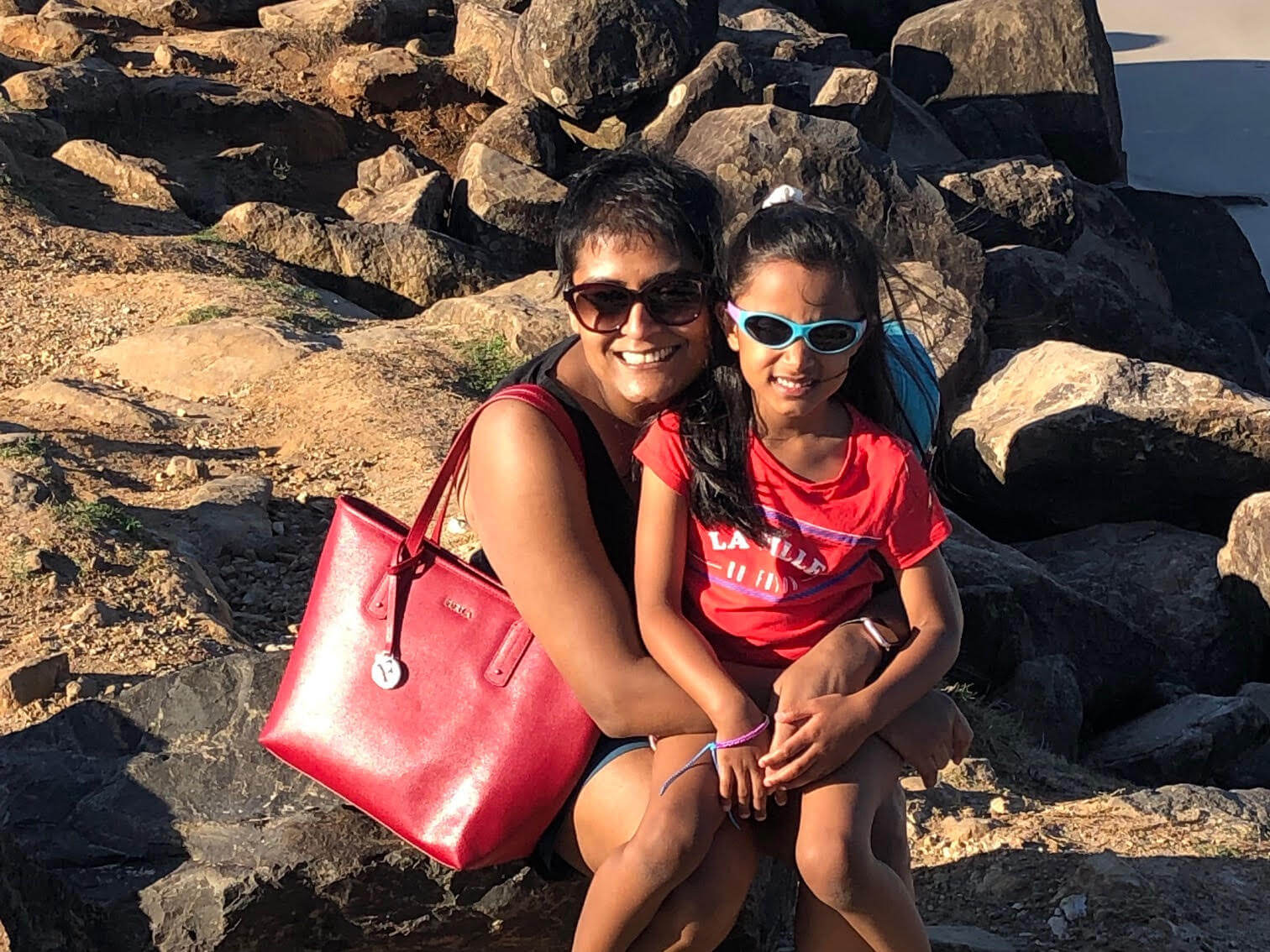
Image credit: Niti Nadarajah
As I revisited the scars that colourism and lack of belonging had left on my self-esteem and psyche, I realised that what my daughter needed was for me to validate her feelings - to validate her desire to fit in and belong.
So when, many months later, she came back from school and told me that she wished she didn’t have dark lips and knees, I told her, “I understand, Mummy used to feel the same way.” I told her that it was OK to feel the way she did and that in time, she would grow to love her skin.
I told her that her brown skin does matter - that skin colour is never irrelevant, and instead something that in time she would learn to celebrate. That it is only natural to want to fit in with school friends who may not have the same skin colour as her. And that just as she feels the way she does about her skin colour, her friends may feel the same way about their own differences - differences in the way they speak English, differences in facial features, their shyness, their hair colour or texture, a speech impediment or disability. I told her that the way we each feel about our own differences is exactly why it is so important to celebrate our differences, rather than hide them.
I even asked her to tell me how she would talk to a friend who was feeling the way she did. Her response was that she would hug them and tell them that she loved them and that their difference was beautiful.
As we spoke, her body relaxed next to me and I felt the cogs in her brain turning as she processed what I was saying.
Many months later, she showed me a page in a comic she was reading, Smile. In the book, the main character says “I realised that I had been letting the way I looked on the outside affect how I felt on the inside.”
Knowing that I often share stories on social media, she showed me the page and suggested I should write something about the sentence. Smiling, I asked her why. Thinking for a while, she turned to me and said she didn’t know. I asked her to read the sentence again and try to explain to me what the girl was saying. She still couldn’t articulate why the sentence mattered, so I asked her to explain what the book was about.
She told me, “Well, this girl has an accident and needs braces. But she tries to hide them as she doesn’t want anyone to know about them. She worries about how she looks.”
I then asked my daughter to recall a time when she had said something similar to me. With a sad look on her face she said, “When I told you I didn’t like my brown skin.”
“Exactly, and what this line is trying to tell you is that you need to focus on what’s inside. On who you are. That you can’t let the way you look affect the way you feel about yourself on the inside.”
Somehow, my daughter knew that this one line in her book was important. The conversations we had been having about inner and outer beauty - about celebrating difference - had started to resonate with her at a deep, subconscious level.
Yes, she will still every so often tell me she doesn’t like her skin colour. But the sadness that accompanies her words is not so prolonged. She has started to understand that, while her feelings are valid, belonging is more than skin-deep. That self-love is important.
She may not love her brown skin yet…
…but somehow I feel that her journey to self-love will be shorter than mine.
Conversations about skin colour and belonging are challenging because they often bring up our own deeply buried scars - scars we may have left untended. The more we confront our own scars, the less likely it is that our children will bear the same.
Indian by heritage and Australian by identity, Niti Nadarajah is a mother of two and a lawyer by profession. She is passionate about the need for more authentic and inclusive leadership and believes these conversations start at home.
Revisiting old scars is second in the series of ‘Conversations with my Daughter’ by Niti, so do lookout for more in the coming months. Perhaps you will see yourself in them. Read the first one in the series, Conversations we never had here.