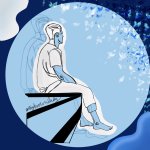
There is a scatter of recurring memories I have of my mother sitting on a mattress with the duvet rolled into a revel, textbook splayed open. The pages are inked with sketches of skeletons with labelled diagrams, exhibited photographs, and highlights of yellow and orange on almost every word. She rocks and forth and says, “I’m not sure why I do it, but it helps me concentrate” as she flips the pages.
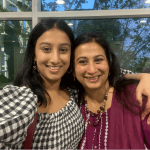
The complexities within the South Asian diaspora take on a unique and often heightened intricacy through interconnectedness from mothers to their daughters. This intergenerational bond shapes our collective experiences through generations of women.
At five years old, I grew old enough to ask for affection. Sometimes if I tap her on the shoulder, she strokes my hair. Those times are rare and I could count the number on my fingers. Most of the time, she pulls her arm away from me and angles her body towards her books.
The years flickered by. I am now fourteen years and my mother seemed to page through the same book, holding onto the same hope that we both knew was a fragment. Through migration, she left everything behind in Bangladesh, her Bengali tongue unaccustomed to the roughness of broken English, her childhood home and the lifelong family, friends and neighbours she grew up with, and the routine five-time-daily sound of the Athan (Islamic call to prayer) heard from her local mosque. She came to a country that could not recognise her medical licence: her decades of academic honour roll and first-in-class awards were now erased.
To make this loss of identity have meaning, she needed to prosper. More importantly, she needed me to prosper. For me to have my mother’s approval, I needed to become who she never got the chance to become.
My life needed to be filled with opportunity, ease, and the abstract construction of a ‘better life’, this was to live vicariously through the career potential or the financial independence just out of reach for her. I needed to be the humanitarian doctor who flies into Bangladesh to offer pro-bono treatment to the most vulnerable members of the community, yet can still be sustainable. An idealised amorphous concept of someone who could give profoundly yet still have.
Her dreams were my dreams, until I was seventeen and realised my own. The implications of following my own path were simple:
I would not be the person my mother wanted to be, in turn, I would never be enough for her.
Learning how to be okay with this, and the unlearning of my identity attached to hers, was one of the hardest experiences I went through. As a second-generation migrant, there was no blueprint or someone I could turn to for mentorship because the diaspora separates my generation from hers, and I confess I did this imperfectly, maybe causing more pain than was necessary. Or maybe the pain is entrenched in the very definition of this experience.
Even at the peak of the realisation of my own identity, I could not truly unlearn my mother’s expectations. Expectations may be invisible but they have weight. I wore mine like a metal chain around my wrist: I felt the tug of heaviness whenever I received a lower-than-expected mark in my studies, fell behind in my coursework, or walked into the screeching echoes of an exam hall.
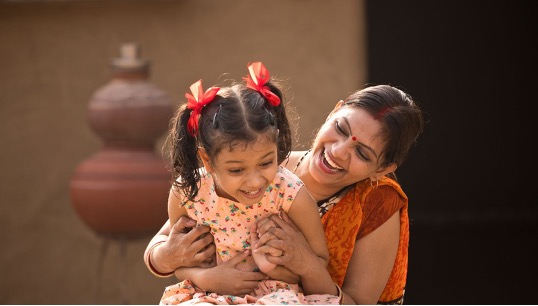
As her only child in a foreign education system, my mother could not guide me and I carried her fear even in my adulthood. There was a risk-averseness tied to all my decisions and a sense of foreboding that maybe I was an imposter. I could not carry my mother’s identity, maybe I am predestined to not build my own either.
For other mothers and daughters in the South Asian diaspora, we seem to share similar narratives. Our navigation of dual identities, the reconcilement of tradition in the forefront of postmodernism, and carrying expectations beyond geographical and generational boundaries.
It was only Islam that acted as the balm to soothe both my mother and my fears - the sense of surrender that everything happens only by design. That everything is exactly how it was supposed to be. That we live in a determinist world and our free will can be subject to, yet still change, the course of events in our lives.
A few weeks ago, my mother and I sat down for breakfast over tea and rusk biscuits as our weekend ritual. Her hair is silver and there are crinkles in her eyes. The textbooks she hovered over since my birth are now in the garage, untouched for years because somewhere along the timeline, she set aside her books and chose to surrender to her bittersweet reality: a life of potential unmet in this life, but insh’Allah fulfilled in the next.
Even to this day, there is a weight that I have something to prove, almost as if the onus is on me to challenge her view, but I think healing is finding the balance between using this to motivate me to live up to my potential and constantly re-assessing what success means to me, versus recognising that I am enough, as I am.
Ramisa is a Queensland-based government lawyer, aspiring academic and writer. You can connect with her via Linkedin.