Eight months ago, I started a four-day work week.
When the idea of participating in Australia’s four-day work week trial was brought up by my Managing Director, many of my co-workers assumed the idea wasn’t realistic in practice.
Initially, I didn’t think a single day off would make the biggest difference to our productivity or my general well-being — but I wasn’t going to say no to trying it out. As someone who in the past has had to work six-day weeks churning out content till I was burnt out, ‘productivity’ as a term doesn’t quite have positive connotations.
A common sentiment that people touched upon was that we’ve been working a five-day week for over 100 years, with little to no change for the better. The four-day work week was definitely worth trying out, even if just for that.
Before the Australian trial started, naturally, some questions arose at work:
Will we have to work 10-hour days to make up for lost time?
No.
Will we have to take pay cuts?
No.
Are some of us just going to be working overtime anyway to get things done?
Absolutely not.
After eight months in, we’ve proven that the whole point of a four-day work week is about working smarter, not harder. I’ll be honest, prepping a four-day work week requires a fair amount of work, collaboration, and ultimately, motivation to get the job done.
Our first month was definitely a bit rocky, but it only got better from there. It’s also not going to be the same across different industries, and I understand how much harder this could be for certain jobs or small businesses.
But did we really expect a change as big as this, to go smoothly from the start? It’ll take time to become the new norm, but I’m proud to be part of a movement that questions the five-day work week, while continuously proving the value of a four-day work week.
Australia’s take on the four-day work week
The four-day work week trial has resonated positively with a recent survey finding one in three Aussies would leave their current job for a four-day work week opportunity. Gen Z believes that work-life balance is an essential part of a company’s culture, and they’re leading the charge against overworking, especially in toxic work environments.
The change to a four-day work week is a concept that sticks. Four-day week global, the program that started Australia’s first four-day week trial, reported that the feedback from the UK trials was good and that out of 60 companies that tried it, almost all were looking to make the change permanent. Post the Australian trial, Labor and Green's senators have shown support for a national four-day work week trial.

The four-day work week improves health in several ways, from reducing anxiety and stress to enabling better sleep and more time for exercise.
At my workplace, an agency called Your Creative, we made it work using a roster system. Our agency is still working five days a week to service our clients. However, in practice, the whole team only works four days — half of us just take a different day off.
There are other models that can work, it’s about finding one that’s right for your workplace. For example, other agencies have decided to all take a collective day off. At Your Creative, we knew a roster system would work best for us. We stick to having internal meetings on days when the whole team is in.
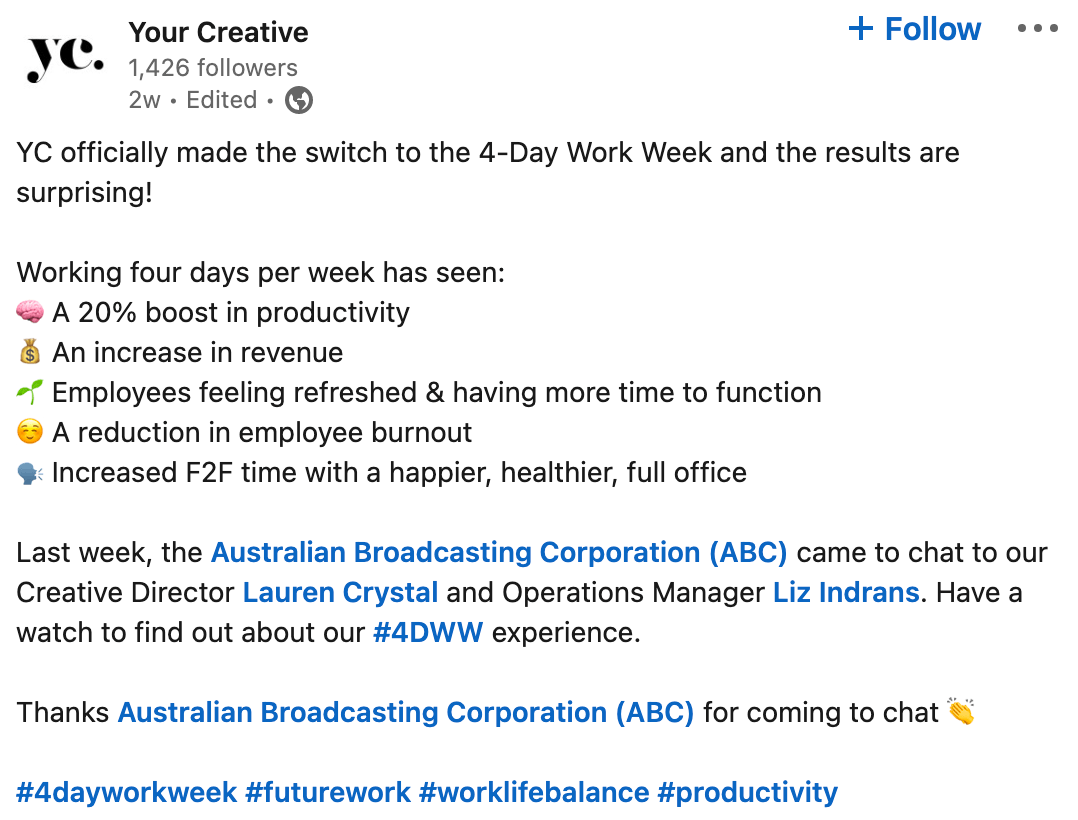
Some of the work benefits I’ve seen from working a four-day week: increased productivity, less procrastinating, more teamwork, and better planning. Every Monday, I know exactly what the week ahead looks like, I understand my priorities and get them done. We have shorter meetings, more focused team catch-ups, and in general, much more efficient days at work.
Making this work relies highly on execution. Our managing director often says this change works when your team is built right — it’s for teams that thrive on collaboration, planning, and communication.
That’s the way we’ve made it work and continue to build on it as we grow.
A week full of benefits
When your team is well-rested, it’s bound to result in better work. Less Sunday scaries or anxiety, more creativity, and more consistent productivity. Studies even show that people can be just as productive in 30 hours as they are in 40. Lauren Crystal, our Managing Director, reaffirms that in her recent article about the four-day week, “If you have a fresher mind, you get a better output.”
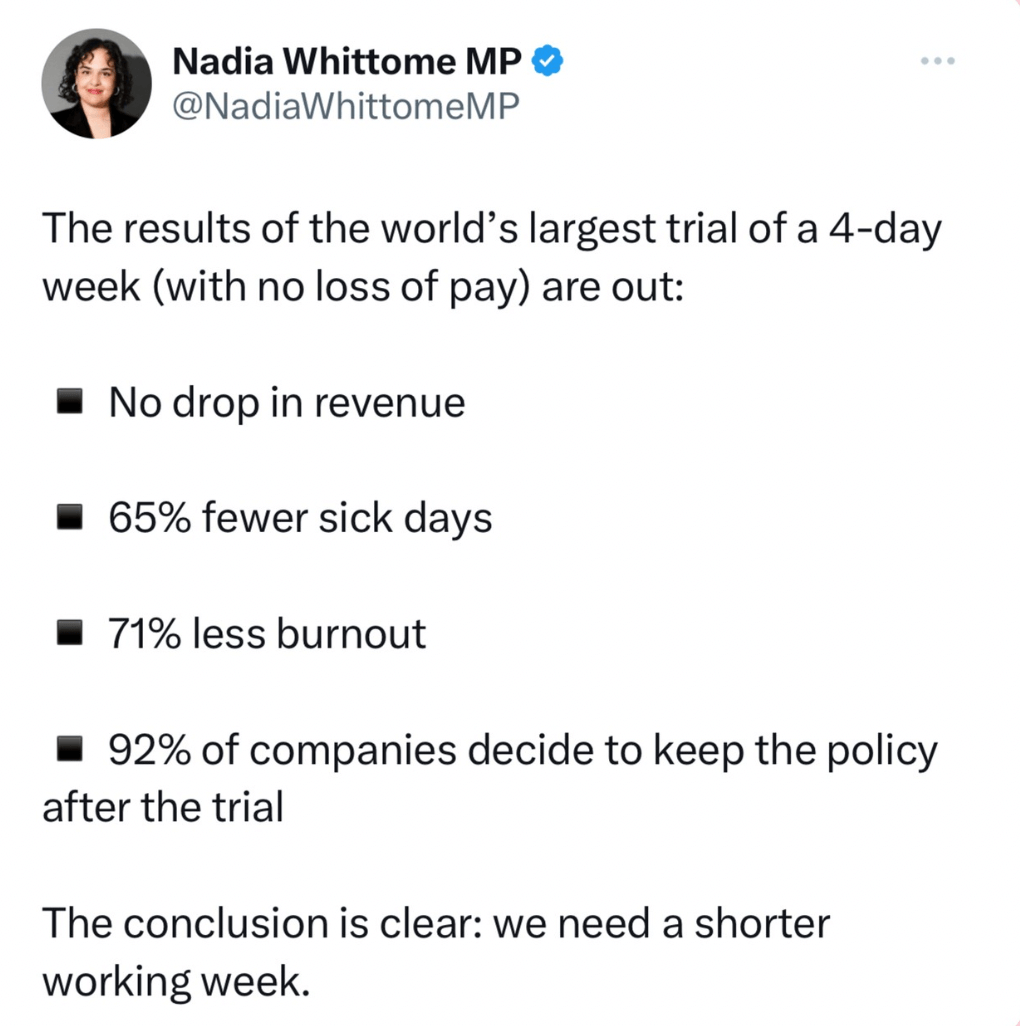
From a health perspective, shorter weeks have been shown to decrease sick leave taken, reduce stress, contribute to lower levels of ‘burnout’ and build a higher employee retention rate.
Within the Your Creative team, the trial was a learning experience for us, and we approached it with a desire to measure how we were going. We conducted an internal survey every month, so we could learn and improve the system. We’d also throw in the occasional question about how people spent their day off.
Initially, the responses floated around getting used to a new routine and sticking to completing administrative tasks or other commitments like childcare. Once there was a routine in place, people’s answers began expanding on how time for old (or new) hobbies began to resurface, commitments to health were being taken on, and family time became more recurrent.

After the Britain four-day work week trial, 71 per cent employees reported feeling less burned out, 39 per cent less stressed and 48 per cent more satisfied with their job than before the trial.
Our final survey in January showed that 90 per cent of the team agreed the four-day work week raised job satisfaction, 87 per cent stated the quality of creative work output had increased, and 60 per cent said it had improved their general health. In our anonymous survey, a co-worker talked about how the mid-week break worked well for them. “I like having that day off to reflect or completely turn off, so I can come back with a fresh look on projects,” they said.
As part of the crew with Wednesday off, I agree with this sentiment about increased energy and focus. I volunteered to be off on Wednesdays as I work best in creative sprints — it helps my focus to work on a project for two days completely, have a break, and then get back into it with fresh eyes. It’s almost like working mini-weeks sometimes, but quite a few of our designers prefer a creative deep-dive for four days straight with the Friday off.
Stepping beyond work, the four-day week has been amazing. I’ve really been able to focus on improving my life. I’ve started writing long-form again, reading every week, keeping my plants and sourdough starter alive, taking on new sports, being able to commit to more social and family activities, and most importantly, seeing a big improvement in my general happiness.
As I’m currently the only person in my social circle who works a four-day work week, it does mean I focus on getting a lot more personal admin done on my day off, which is normally cooking for the days ahead, ticking off personal appointments and having the occasional date night (or day!)
If I had to vote for a four-day work week, there’d be no doubts about which way I’d swing. That resounding yes echoes across millennials who are finally starting to take a step back from burnout and hustle culture, while Gen-Z continues to promote putting life before work and finding a better balance. I truly believe that Gen Z’s is the final push we’d need to make this change a permanent reality.
Ultimately, a work-life balance is truly about being able to spend more time just living your life — I’m glad I get to appreciate that now, more than I ever did before.
Cara is a Content Strategist at Your Creative, a creative agency in Brunswick and an occasional freelance writer. As Content Strategist, she helps brands understand why and what they need to be saying — more human, less salesy. Her current interests include UX Writing, AI, trying to keep her plants alive and indoor beach volleyball every week. She also loves reading, ginger chai, and baking. You can connect with her via Linkedin.