When Ashani was in high school, she was insecure and anxious. She hesitated speaking up in the classroom, was stressed about her grades, wore a rash vest to her knees during swimming class, and was disassociated with her Sri Lankan heritage to fit into her predominantly Caucasian community. Now, she's the Founder of a not-for-profit organisation empowering teenage girls. The Sydney-based 30-year-old spent years reflecting on her formative years, and through this introspection and building of self-confidence, she birthed Flourish Girl.
What is ‘Flourish Girl’?
Flourish Girl is a Melbourne-based, not-for-profit organisation that creates rite-of-passage programs for teen girls and gender-diverse teens to flourish in schools. The programs focus on building the self-awareness, self-confidence, and social connectedness of girls between the ages of 13 and 17, with the essence being that ‘every girl is a flourish girl (inclusive of all gender expressions)’. The three-step program facilitates workshops designed to empower girls to ‘flourish with self, with the community.’ Flourish Girl first found its place in Victorian schools in 2018, and since the program has reached more than 12,500 students in 80 schools.
When Ashani first stood up in a school in 2017 as the founder of Flourish Girl - she was a one-woman show. She was the founder, the accounts manager, the facilitator, and more. “It was nerve-wracking! I didn’t know how the students were going to react,” Ashani recalls. Today, Flourish Girl has flourished into a formal organisation complete with a strong team of 4 Flourish Girl staff, 30 facilitators, and five board members. “I could feel the safety that was being built in the room, and I realised how much girls needed that safe space,” she said.

The journey of starting ‘Flourish Girl’
Before building Flourish Girl, Ashani was a paediatric speech pathologist for two years. She also ran her own public Instagram account where she reflected on her younger years. Ashani recalls seeing girls in her school year with bandages on their arms or partaking in crash diets to lose weight and admits that these experiences stayed with her. By her admission, she had a “quarter-life crisis” and questioned if speech pathology was the right path for her. Leaning into her social media reflections, Ashani spent time learning about mental health, particularly in young women. “There was a lot about empowerment, but very little about the base of that - confidence, awareness, and purpose. I questioned what we could do at a preventative level.”
Ashani then resigned from her job, moved to Melbourne in late 2016 to be with her husband, and studied to attain a Diploma in Group Facilitation, acknowledging that she needed a qualification and skill set to hold space in this environment. She made connections with the social change community and became a facilitator. Through her work with youth-led organisations, Ashani was then approached to lead the feminine programs in schools with the Rites to Passage Institute. “I not only built the school arm of that program, but I built my skills and knew from then that I wanted to do something like that for teenage girls specifically,” she said.
The Founder’s Personal Journey
For Ashani personally, Flourish Girl bolstered her growth and patience. “I was so passionate about this idea, but I needed to be patient with other people trusting my idea and seeing what I bring to the table. I learnt [with] patience and the knowledge that I am walking my unique path,” she reflects. Ashani also credits her “tribe” on her journey, acknowledging that being able to build a community of people around you that encourage and challenge you also inspires you.
She has also learnt to prioritise her personal and spiritual development and practice, with a focus on mindfulness, intuition, reflection, and listening. “I realised over the years, especially as the founder of this organisation, that I need to be responsible for my flourishing journey and being able to connect with myself. I believe that because I have been able to do that… that I have been able to attract lovely souls as well,” Ashani acknowledges.

Circling back to her teenage years, Ashani's journey has allowed her connection to her cultural heritage. And though she initially shunned her Sri Lankan heritage, Ashani now appreciates the wisdom and beauty in her culture. An example of her building the bridge back to her roots is her move back towards her actual first name. She previously went by 'Mandy', short for her middle name Amanda, in an attempt to acclimatise to the Western world.
“I have been on a journey of decolonising myself, and one of the things I have realised is how I have not been embracing all of me… I am on a slow journey of bringing my first name, Ashani, into my everyday life outside of just my family.”
Additionally, Ashani has now taken the step to encourage all Flourish Girl staff and participants to use their full, non-Anglicised names and ask them to teach those around them how to properly pronounce their names. Ashani also acknowledges her family and the sacrifices her parents made for her and her elder sister Mel to give them the best opportunities. The journey has not been easy, but it has allowed for greater appreciation, awareness, and connection.
The Impact and the Future
And it appears that Ashani's, and the team at Flourish Girl’s, hard work is paying off. With demand increasing and more schools wanting to offer the program to their students, Ashani remembers a few stories from past participants that have stayed with her. “A girl that was being bullied reached out to us a few days after we ran the program at her school. She said that she was supported and stood up for by another group of girls. She thanked us for showing them what sisterhood and community look like, as well as helping them find their voice,” Ashani recalls.
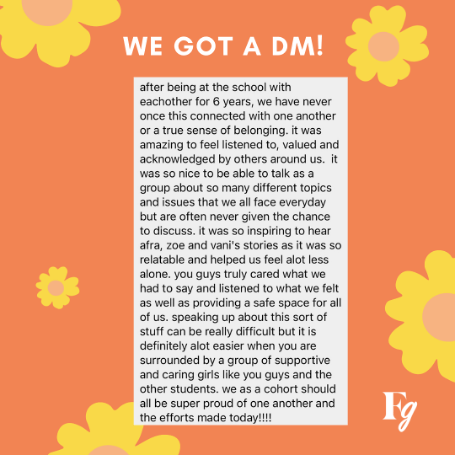
Looking forward, Ashani wants to continue to build a robust program that is easily accessible to all those who need it. To do this, Ashani acknowledges it is important to step back and reflect on what is working but also what isn’t. The organisation is currently getting an evaluation done to show how their programs are demonstrating long-term change to have evidence-backing and subsequently to be able to further scale their impact. “It is thought leadership. We are starting to pave something different, and we want to build a sustainable organisation,” Ashani said. Part of this will be to bring alumni together to connect and reflect, as well as grow the Flourish Girl team to cater to growing demand.
Much like most of our conversation, our chat ends on a reflective note, with Ashani wishing she had access to something like Flourish Girl back in high school. “I spent so much time trying to heal that if I had access to something like this, I wonder what else I’d be capable of,” she said.
It goes without a doubt Ashani has created something special. The team at Flourish Girl has taken leaps and bounds to ensure that teenage girls have the right tools to feel confident, aware, and heard, building a generation of empowered South Asian women.
You can learn more about, donate to, contact Flourish Girl via their website: https://www.flourishgirl.org/.
Tia is a freelance journalist from Sydney.