Australia's South Asian communities, along with other minorities, continue to face systemic racism in schools, workplaces, and public spaces, says a new Human Rights Commission report.
Racism remains deeply entrenched across Australia, affecting individuals from all walks of life, regardless of their location, age, disability, sexuality, faith, or cultural background, reveals the new report from the Australian Human Rights Commission (AHRC).
The report, An Anti-Racism Framework: Experiences and Perspectives of Multicultural Australia, also holds governments and the media responsible for further marginalising individuals by either ignoring or downplaying incidents of racism or promoting division through sensationalist rhetoric.
Commissioned by the AHRC and conducted by the Federation of Ethnic Communities’ Councils of Australia (FECCA), this report contributes to the National Anti-Racism Framework, which the Commission will present to the Federal Government on 26 November 2024.
Racism is often being experienced at the same time as another form of discrimination, such as disability or sex discrimination, and is taking place in people’s schools, workplaces, public spaces, and during interactions with health services or law enforcement, the report found.
“These powerful and, at times, heartbreaking first-hand accounts from diverse and marginalised communities reaffirm the fact that racism in Australia is ubiquitous, insidious, and profoundly damaging,” says Race Discrimination Commissioner Giridharan Sivaraman.
“The racism described is more than hurtful words being said to someone. It is systemic, often involving dealings with some level of authority, whose power determines access to opportunities, basic needs, services, or justice."
“Racism seeps into almost every aspect of people’s lives, and in ways that have become so normalised that victims don’t feel they can talk about it and decide to ‘learn to live with it.’ Every day, racism is hidden in plain sight."
“People spoke of how they felt they had to lose their identity to fit in, their experience of subtle acts of discrimination or alienation at school, work, or their communities, and biases they felt in dealing with those in power. Sadly, people not feeling safe because of their race is widespread,” Commissioner Sivaraman says.
From November 2023 to May 2024, FECCA engaged 18 organisations nationwide, using an intersectional approach and prioritising groups most likely to face racism and discrimination.
Over 860 participants participated in 44 consultation sessions across all states and territories, and an online survey received 411 valid responses.
The participants often linked racism to physical appearance, gender, language, country of birth, migration status, cultural practices, religion, and food habits.
“Racism is discrimination in language. When I arrived in Australia, I felt it was impossible to live because I didn’t speak the language. To fit in, I had to lose my identity,” states a community member in Sydney.
“You have been told that there are LGBTQ people in this land, and that makes us feel like we wanted to come to this country. When we arrived in this country, the expectation was not there. We’re not the type of LGBTQ people that we need or want in this country. I guess it’s because of the color of our skin, the accents we speak, how we speak, and how we dress up and perform ourselves in the public area,” says LGBTQIA+ communities.
Some participants spoke explicitly about racism as part of Australia’s history and how its effects are still being seen today.
“My ten-year-old daughter was sitting outside of Kmart, and she noticed the lady that was checking the bags was letting non-Indigenous people go through and checking Indigenous people’s bags. And she said, ‘Mum, I don’t like that lady. What she is doing is wrong.’ And you know, if a ten-year-old can see that, that’s wrong,” participants from the faith community said.
How Racism is Experienced
People noted that while racism often showed up as microaggressions, derogatory remarks, bullying, and stereotypes, these behaviors were linked to larger systems.
“I have difficulties going to the chemist because they always think I am stealing; this has stopped me from accessing essential medicine that I need as I do not feel like going there because of how they make me feel when I am shopping,” reveal young participants.
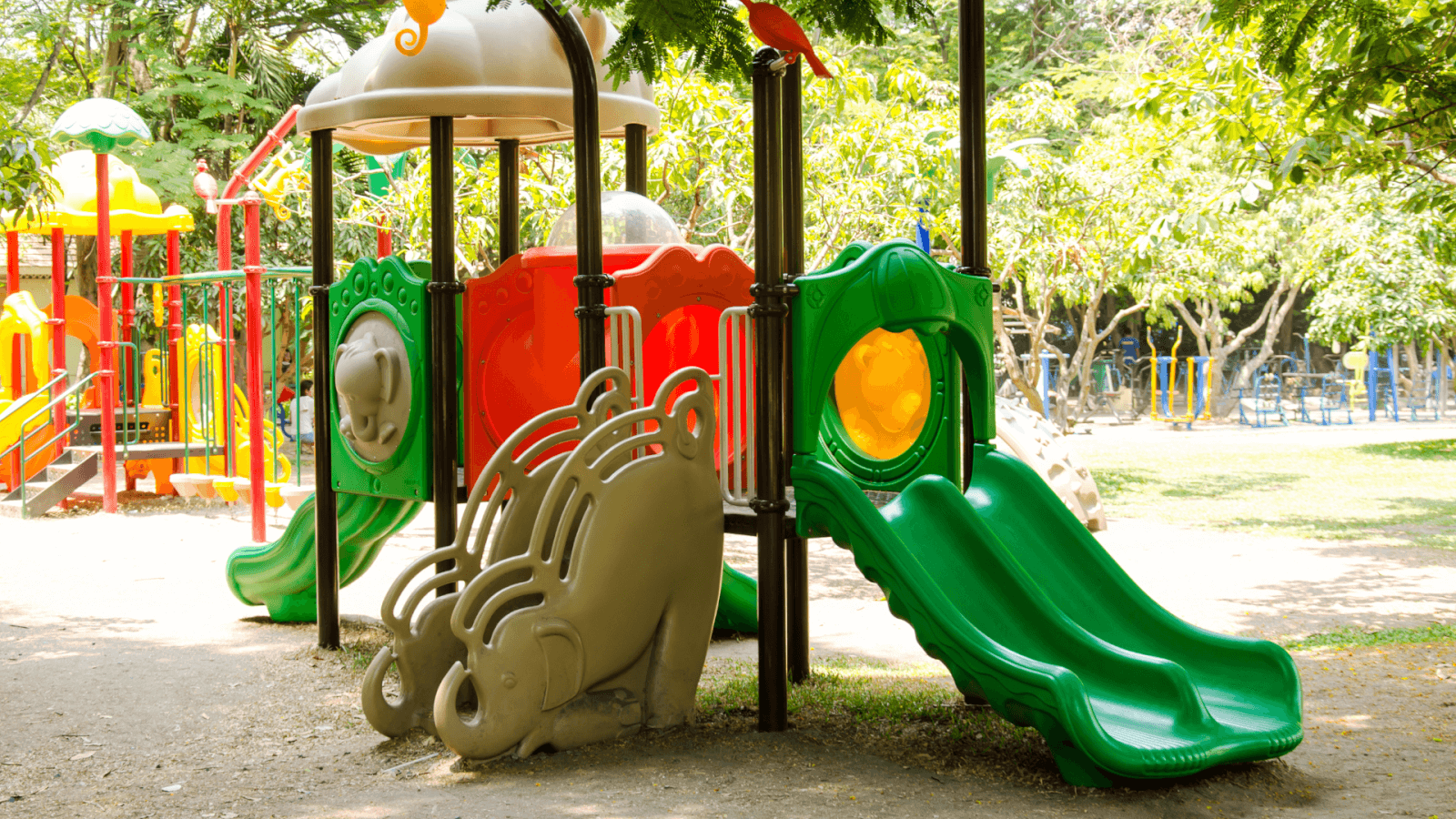
“I was taking my children to the park one day, and there were 3 other mothers. As we approached the swings and the slides, one mother told her child it was time to go home because the playground was no longer safe. Right there and then, I turned to see what she meant by that, and then it dawned on me that she was referring to my children and me. It is unfortunate to witness such behavior and attitude without understanding its cause and effect,” reports refugee participants.
“Parents in childcare choose white educators to talk to. Parents do not want to speak to educators other than white people,” says new and emerging communities.
“In a meeting, I asked a question, but the client addressed my white colleague even though I was his boss,” highlights a member from new and emerging communities.
These experiences call for an urgent need to address the normalisation of everyday racism and its acceptance as something that one has to learn to ‘get on with.’ When people shared their experiences, the most common places of racism were schools, workplaces, health care services, and interactions with the police.
Racism in Schools
Studies have shown how students experience racism in Australian schools. Now, young people and their parents speak about both direct and indirect discrimination in the form of racial slurs, stereotyping, and lower expectations from teachers.
“We are supposed to be safe in our schools. But if teachers discriminate, who do we go to?” says a participant.
“Because of my hijab, I was treated differently in school… the kids all stared at me. It made me feel uncomfortable. This was a massive shock to me,” said a refugee.

Some also state that school teachers did not believe in them despite showing their abilities.
“In high school, my teacher told me that I should not do physics and chemistry because it did not make sense for someone like me to be in those classes,” says a youth.
“It happens a lot in the field that. Black people are not seen as intelligent enough to do it. A lot of the time, when I am in class, some people may feel Black people cannot contribute to certain things because they feel like they are not capable. I have seen this happen to other Black people and have personally experienced it,” says another.
“My nephew is 8 years old. Kids were playing, and some sort of disagreement happened, and they called him a [N-word]. My nephew got mad and started a fight. The school called home and told us to get him because he was being violent. His punishment was to go home. This was unsatisfactory as they never addressed the issue, which was the kids being racist to my nephew.
I believe the school was too afraid to deal with the problem. The other kids got nothing because the new problem became my nephew being violent instead of their racism,” claims a young participant.
Racism in Workplaces
Racism in workplaces was commonly mentioned, with participants talking about encountering racism in the process of applying for jobs. Many, for instance, cited the need to change names to an ‘Anglo-sounding name’ to increase their chances of getting a job interview.
“A person’s name can affect employment opportunities. I had 1 in 10 interview opportunities before I changed my name. I had 10/10 interview opportunities when I changed my last name after marrying an Anglo-Australian. I specifically named my kids English names, so they don’t have to go through the same things I have been through,” says women participants.
“At work, there are instances where supervisors don’t grant annual leaves or sick leaves to Asians,” says a participant from new and emerging communities.
People also discussed how employees from minority backgrounds tend to face additional barriers to promotion and career advancement.
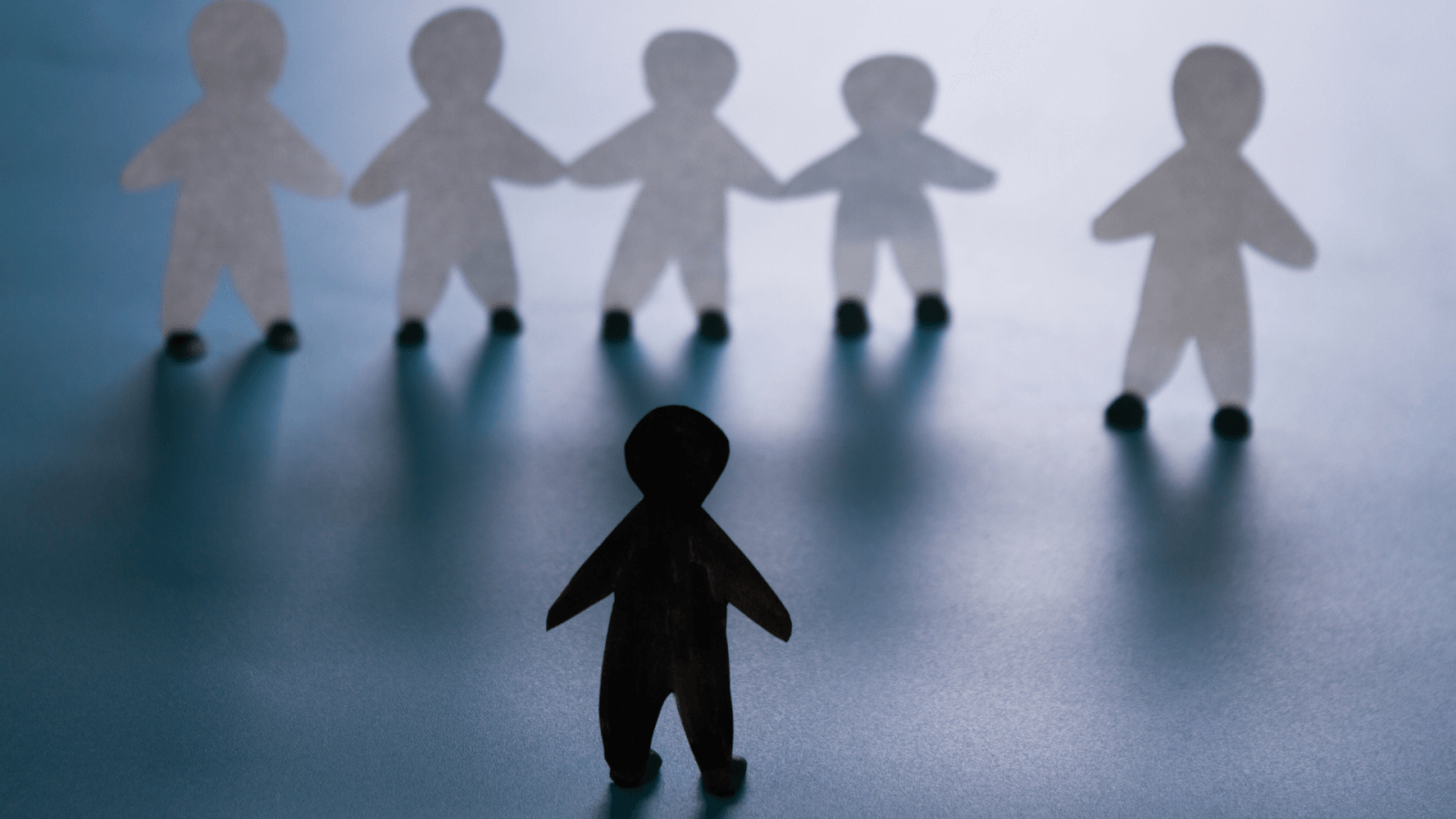
“Some people don’t get a position even if they pass all the requirements,” says a participant.
“In work environments, individuals from migrant backgrounds often find themselves underrepresented in high-ranking positions, such as on boards. In the public service, it is more difficult to get promotion as a non-white Australian,” adds another.
Similar to experiences in schools, participants felt unsafe and unprotected when it came to reporting racism. They lacked trust in the reporting process and feared potential negative consequences for those who spoke out.
“You just feel you should ignore it and get on with life, focus on the future,” says an individual.
“If you are reporting, you can be made to feel that you are a troublemaker, you have to put it in writing. It can be mentally extremely stressful. The process and paperwork can be complicated and confusing with no certain outcome,” says participants in consultation in Canberra with various cohorts.
“Sometimes the consequence of being silent about racism is better, especially in the work environment, as you can lose your job or make the workplace uncomfortable,” said a member from new and emerging communities.
Racism in Healthcare Services
People described discrimination throughout their healthcare experiences, from access to quality care. They also highlighted challenges like racism from interpreters and a lack of cultural competence among health service providers.
“My two-year-old was sick, and we went to the Emergency Department, she had asthma, and the nurse put a mask on her to get her oxygen, she was rough and put it on very tight, it was hurting her, my daughter was very stressed and nervous, she could not breath but the way the nurse was treating her was not helping her to calm down and it was making me angry."
"Afterward, I thought about what had happened. I was concerned that the nurse was treating us like this because we were Muslim, were dressing differently, and didn’t speak English then I also thought maybe she did not know much about us or perhaps just a bad day and was very busy in the emergency and my daughter is struggling against what she needs to do. It is hard to know, but still, it makes me feel bad,” narrates a refugee.

“There’s a clear bias when accessing healthcare. The assumptions made based on my cultural background affect the quality of service I receive. There’s a need for cultural competency training across sectors,” says another refugee.
“A tall, very lean African boy is not considered likely to have an eating disorder, yet this happened, but it took a very long time for diagnosis and therefore treatment, putting that person in danger,” says a youth participant.
Role of Media
The media is a powerful tool that shapes notions and images of what it means to be ‘Australian’ and to belong to the nation. This includes not only the stories that are told but also who tells them. However, in Australia’s current media landscape, professionals from multicultural backgrounds are still underrepresented.
Concerns were also raised on how racism is not discussed in Australia because mainstream media is silent on the issue.
“The media supports racism. For example, when an African athlete in Australia does good, he is labeled as Australian, but when he does wrong, he is identified as African.
“There was someone who committed a crime. In the news, they said it was a middle-aged Australian man, Caucasian, etc. They said he has mental health issues, which is why he did it. Whereas you see in another one, they say African man that has come to Australia did it and that he should get deported,” emphasises a young participant.
“There is particularly racist coverage in the mainstream media of Asian and Muslim people,” states a member of community media.
“How often do you see a story about racism in the mainstream media, unless it’s huge or becomes a scandal? The change has to happen from the mainstream. Mainstream media has a lot to answer for. It’s about finding a more positive and aspirational way of living, respecting each other, and bringing people with you,” another member of community media states.
Caste-Based Discrimination
In 2022, the Commission recognised caste-based discrimination as an intersectional form. Giving continuity to that process, the consultations organised by FECCA included specific consultations on caste discrimination in Australia.
Participants reported the worst of caste identity-based discrimination in the form of physical assault, being treated as untouchables (especially children), and socioeconomic boycotts on businesses and persons.
“The results also pointed towards the presence of overt and covert forms of prejudice and discrimination based on the caste identity in education, employment, and marriage, intersectional discrimination based on gender and religion (and, of course, caste), and exclusionary practices that make caste as the central consideration of socio-cultural and socio-economic life in Australia within the Indian diaspora community.
The impact of such pervasive discrimination was negative, and it significantly affected the well-being, mental, and psychological, of the caste-oppressed persons,” states a report from consultations with caste-oppressed communities.
Addressing Racism: An anti-racism Framework
Consultations aimed to learn how people who experience racism want to address it. Participants highlighted that while racism appears in relationships, communities, and institutions, the focus should be on systemic change. The first step in that process would involve breaking the silence around racism.
“To address the issues of discrimination, bullying, harassment, and racism, first, we should admit that there is a problem, and it happens every single day in almost every situation,” suggests refugee women.
Government commitment and action, such as enforcing laws, enacting policies, and holding media to account, were identified as essential to creating change.
“I suppose we are the agents of change on an individual level. So, we must take agency for our actions, decisions, and thinking. But on a systemic level, governments can do a lot to offer those ways of thinking and doing and behaving, and policies and frameworks can help us guide that,” believes faith communities.
“When making policy or laws – consult directly with the community. You never know if there’s hidden bias. Don’t assume the solution; have the community inform the solution,” says young people.
Education was identified as a critical area for anti-racism actions.
“We need to build trust in the community via early education. Education needs to start before five years of age. Children need to be educated beyond Harmony and NAIDOC week. This needs to be an important part of the curriculum, in scale with the actual problem, and parents need to be aware that this is a serious part of the learning because, often, racism starts at home. The systematic change of the education system will inevitably overflow to adults, who have grown themselves in a racist environment,” participants say.
“Schools must develop a stronger commitment to acceptance, tolerance, and culture. This would include training and support for management, teaching, and other school staff and the inclusion of this in the curriculum for the students,” they add.
Currently, a common approach in Australia is to address racism in workplaces through unconscious bias training or diversity training. However, evidence suggests that anti-bias training is not effective.
“Many participants stressed the importance of not only establishing but knowing and using feedback and reporting mechanisms in their workplaces and the communities in which they reside,” states a report on consultation with new and emerging communities.
“African proverb: you can’t be bitten by a snake and report it to a crocodile. This proverb is used as an example to explain how the community feels when they report incidents to a police officer who doesn’t look like them. This also refers to reporting to someone who doesn’t have your experience, who is usually the person who will make the final decision,” feels newly arrived migrants.
There was a call for the press to play a more positive role, with narratives that show the success stories and social, economic, and cultural contributions that multicultural communities, including newly arrived groups, bring to Australia.
“Ending racism requires a collective effort from individuals, educational institutions, media, and government. The media is responsible for presenting accurate and unbiased information, avoiding perpetuating stereotypes or discriminatory narratives. Promoting diverse voices and perspectives in media content can help combat prejudice and promote a more inclusive society,” says community media.
Overall, community members proposed a shift in how racism is addressed in Australia. It was clear that actions to address racism and prevent it from happening should not be a burden on those who are most likely to experience it.
The Government, media, and institutions we encounter daily, such as the places we work, schools, healthcare providers, and sports clubs, should play a central role in building an anti-racism agenda. At the same time, actions should emphasise a collaborative response among multicultural communities.
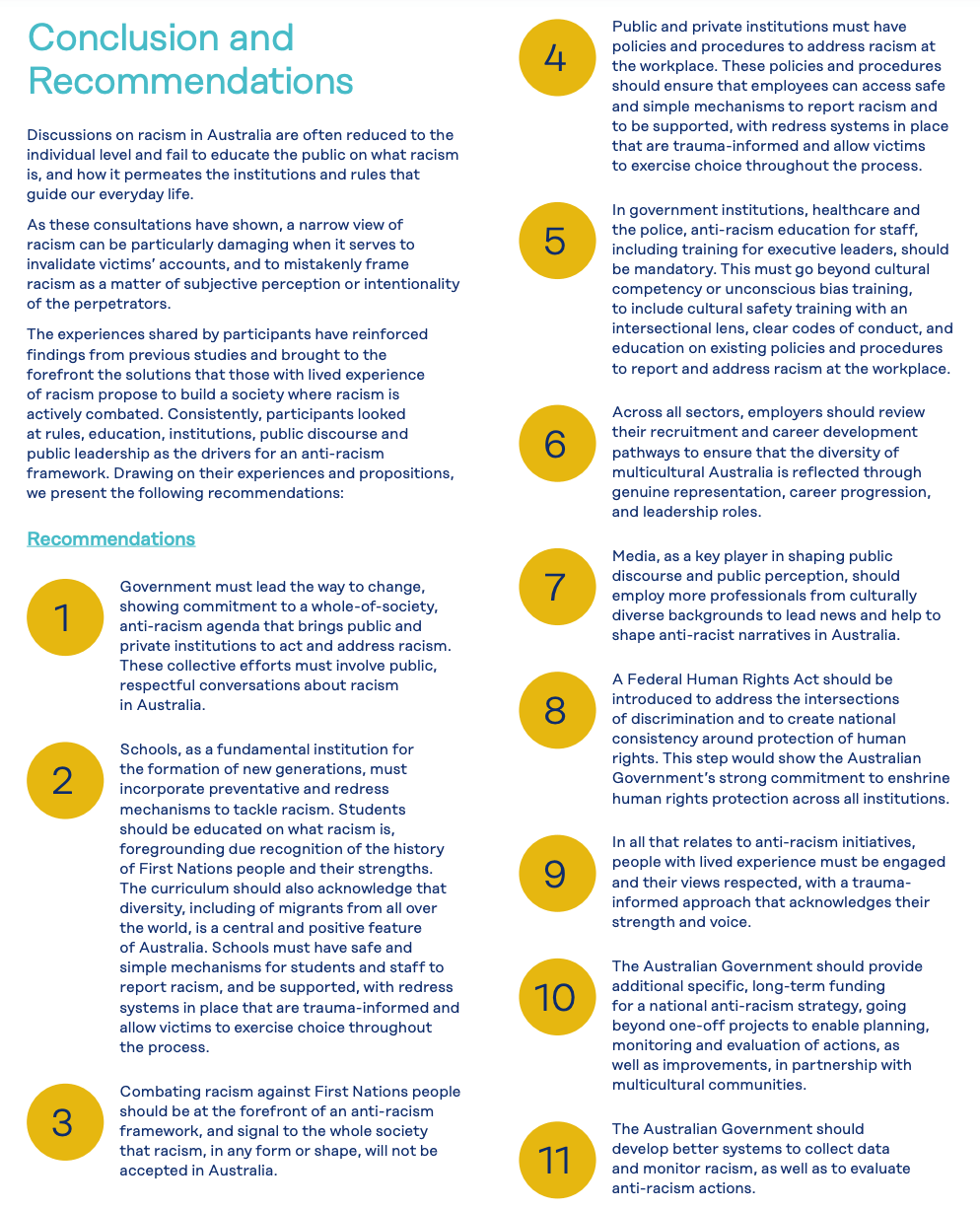
Drawing on their experiences and propositions, the report made 11 recommendations.
“The first step to systemic change is to break the silence around racism. No longer should victims just ‘get on with it,’” Commissioner Sivaraman adds.
“Racism is a barrier to ensuring all Australians are afforded the same opportunity, dignity, respect and access as others. We must urgently have a sound human rights protection system that establishes a safe and inclusive environment for all.”
“This report shows the need for a comprehensive anti-racism strategy in this country has never been stronger, says FECCA Chairperson Carlo Carli.
“We are delighted that the voices of people with lived experience of racism will help shape the National Anti-Racism Framework, driving meaningful change and accountability across all sectors…
“By incorporating the insights of those who endure this daily, the National Anti-Racism Framework has the potential to dismantle discriminatory structures and build a fairer society for all.”