We, at SAARI Collective, continue our celebration of the incredible South Asian Women working in STEM and leverage this spotlight to draw attention to the tremendous efforts and immeasurable contributions made by them across Australia.
It is a well-known reality that Australia’s STEM sector does not represent women and gender diverse people sufficiently – whether that be in classrooms or the workplace. The glass ceiling gets all the more real when you add race to the mix and makes the idea of establishing a career, an identity, as a South Asian woman in STEM daunting. Our purpose behind this series is to vocalise the challenges and showcase the resilience of some of the South Asian women working in STEM across Australia.
Today, we conclude our series by sharing the journeys of Dr Sanam Mustafa and Dr Krati Garg and invite you to join us in recognising and celebrating their journeys – packed with humble beginnings, experiences surrounding challenges, explorations of cultural identity, learning and unlearning, small and big wins and the unceasing desire to grow. Let's amplify their stories and inspire the ones to come. Let's turn the 'well-known reality' into shattered fragments of glass.
Profile - Dr Sanam Mustafa
“If you have a passion, you can achieve your goals. The road may not be easy, so find mentors you respect. The people you surround yourself with are key for your success.”
 Dr Sanam Mustafa truly encapsulates what it means to be a powerhouse woman in STEMM. She is currently an ARC Senior Research Associate at the University of Adelaide. A large focus of Dr Mustafa’s research is to help develop novel tools used for sensing and investigating intracellular signalling. She works closely with physicists, chemists, engineers, and psychologists to “tackle real-world problems from new perspectives”.
By encompassing tools, technologies and knowledge from a wide variety of research areas, Dr Mustafa’s research is applicable in a range of industries, from “medical to agricultural, sports and to even defence”. In 2019, she was awarded the ‘Faculty of Health Sciences Executive Dean’s medal for Engagement & Advancement’ for her engagement with the Defence Science and Technology group and advancing the reputation of Adelaide University.
Adding to the list of accomplishments, Dr Mustafa was also named Science Technology Australia’s inaugural Superstar of STEM, which she says “empowered her to passionately advocate for gender, equity and inclusion”. She is an active member of several different committees, including the Faculty of Health Sciences GEDI committee and the Science & Technology Australia’s (STA) Equity, Diversity and Inclusion committee and is on the board of aKIDemic Life, an online resource that helps academic parents navigate through the challenges of parenting and a career in academia. To add to the running list, Dr Mustafa is also the Vice President of BliSS Science and Innovation Inc., a non-profit organisation fostering & enabling multidisciplinary collaborations, and a mother of “two beautiful, independent” daughters.
The invaluable value of education
As a second-generation migrant growing up in a small town in Scotland, Dr Mustafa admitted that she “had never dreamed of such accolades or a successful academic career in South Australia". While her passion for biology started at school, it was her mother who encouraged her to prioritise her career. “With the support of my mother, I was the first person in my family to complete school and gain a university education,” Dr Mustafa stated. She reflected on her grandfather’s experience when migrating from Pakistan to the UK in the 1960s, an “economic migrant [who worked] his way from the mills to becoming a successful business owner”. As a result, she found her upbringing rewarded financial stability over education, reflective of her family's experiences at the time. However, it was Dr Mustafa's mother who broke away from the pattern to vocalise the importance of education, especially for women.
“My mother invested her time instilling in me the value of education and painting a picture of how it could change my life. And it did.”
Despite her mother's encouragement, Dr Mustafa felt that a lack of role models “definitely impacted [her] career ambition”. Particularly coming from a South Asian community, she observed that many of her South Asian friends at university did not want to, or were unable to, pursue postgraduate studies. “Many of my South Asian friends in my cohort or in the years above me at university were there not because of their passion for learning but to delay their inevitable marriage…their ultimate fate (often by choice) was a decorative degree followed by a wedding,” she conceded. She recognised that these are highly complex challenges which several women of colour continue to face in their communities or homes. “Often these challenges can start in the home environment if there is a lack of support or visible inspirational role models…these can lead to a lack of confidence and ambition in the workplace despite the presence of abundant talent,” Dr Mustafa claimed.
Particularly in South Asian communities, where women may often “disproportionally carry the burdens of caring duties”, Dr Mustafa urges, “it is critical to support women who return to work following a career break due to maternity leave or care of a family member”. She believes meaningful efforts should be made to role model and celebrate successful South Asian Australian women and women from diverse backgrounds to believe in themselves, their abilities, impact and valuable contribution to their communities.
When asked to share a message for aspiring or emerging South Asian girls and women looking for a career in STEMM, Dr Mustafa provided some powerful words of encouragement. Through her journey so far, she has learned to recognise that “no one has a defined career path.” She states it is vital to trust your gut and be open to opportunities.
“Learn to recognise opportunities. If there are none, create them [and] be creative."
“It is so important to stand out from the crowd, especially in competitive fields such as science. Whether it is tapping into your current network of teachers, lecturers and colleagues, or making new connections, it is important to put yourself out there,” Dr Mustafa adds.
She concludes with a call out to the STEM community and says "I believe in #KindnessInScience and the power of role modelling and mentoring to keep the light shining bright.”
You can connect with Dr Sanam Mustafa via LinkedIn.
Profile – Dr Krati Garg
“However cliched it may sound but the world is indeed your oyster. There is nothing impossible if you persist and persevere. We must learn to respect and embrace our diversity, our heritage and what makes us different. That is also one of our biggest strengths.”
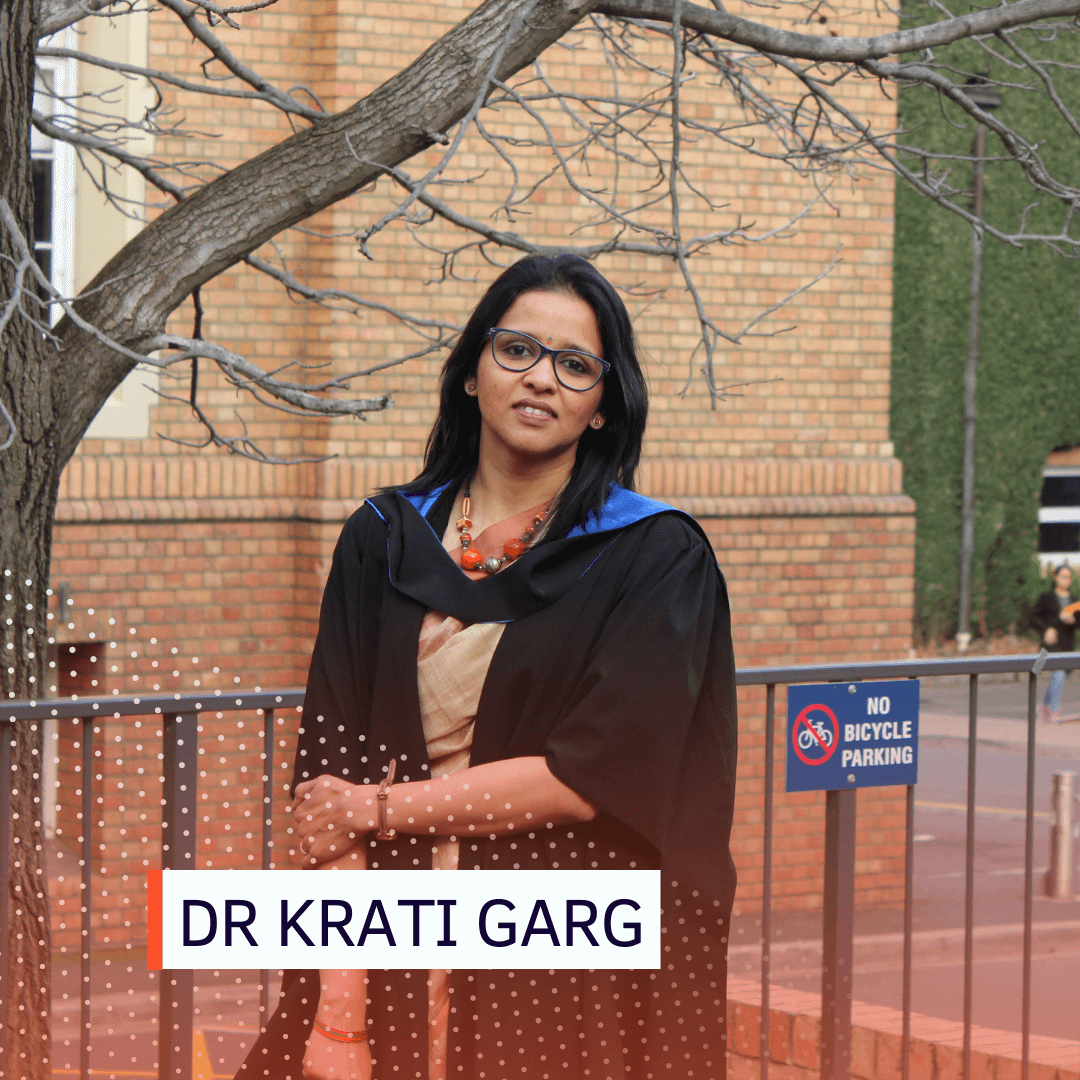 Krati Garg’s multifaceted love for writing and sciences blends and shapes the life she lives now - one which informs, educates and initiates dialogues in the much-needed spaces. An Oral Surgeon and an occasional freelance journalist, Dr Garg completed her dental undergraduate and a postgraduate specialisation in Oral and Maxillofacial Surgery from India before migrating to Australia in 2007. She registered here as an oral surgeon after completing her licensing examinations and then pursued a Master’s in Journalism from the University of Melbourne to fulfil a long-held dream.
“There is immense pride and satisfaction in being a health care worker, to relieve someone from dental pain, which is one of the most excruciating pain in the body, is instantly gratifying. But I also love writing and telling stories that resonate with people. Writing has this power to connect people through words that validates their experiences or informs them of something they never knew.”
As a young girl growing up in India in the 80s and the 90s, young Krati dreamed of being a journalist or having a career in theatre. However, the reality of the community around her at the time and her interest in biology saw her take an alternative path and prepare for the highly competitive medical entrance test. Having missed the medical entrance cut-off by a mere 0.6 per cent, she set her eyes on the field of dentistry, fascinated by the surgical aspects of the field. Her hard work finally paid off as she succeeded in securing a position to train for Oral and Maxillofacial Surgery ahead of thousands of aspiring dental graduates across India. She then moved to Australia where she had to cross a few more hurdles to be able to practice her vocation. “When I look back now, I have absolutely no regrets about all the struggles I went through to be where I am. I don’t think I would have made a good actor.”
Navigating all-too-real biases
Dr Garg states that surgery is not a gender-balanced speciality anywhere in the world. “I was the only woman to opt for oral and maxillofacial surgery out of the seven positions in the national postgraduate entrance test. I remember we were standing in a queue, to declare our chosen speciality to the admissions office, and this person behind me said to me, “Are you crazy? Why don’t you take paediatric dentistry?”. That gave me a glimpse of how the world perceived women in surgery.”
Dr Garg was surprised to find surgery a male-dominated speciality in Australia as well and says that the country has a long way to go in terms of gender balance. “At the moment, the bigger battle is to get equal pay, equal opportunities, respect and a fair go as a woman. There are 13 per cent of women in surgery in Australia. Let that ratio change a bit, and then we can reassess if it is a fair representation of every woman aspiring to be a surgeon,” she says.
Reflecting on her journey as a woman of colour navigating her way in Australia, Dr Garg recalls an instance from when she was studying journalism at the University of Melbourne - “I was selected for best student portfolio during my Masters a few years ago. Someone had said to me jokingly that I got the award because I was the “token diversity student” I was stunned for few minutes but I could not let that get to me. I would be dishonouring all that I had put in to pursue writing”. She chooses to see her ethnicity and her background as a strength. Dr Garg says it is a privilege to be able to cherry-pick what is best in her two worlds - the one which she inherited and the other she is living in.
“There is no denying that India was largely a patriarchal and conservative society for a very long time. And it is easier for the western world to keep holding on to that narrative about India. But things have changed rapidly in the last fifty years. We definitely need to acknowledge our past and learn from it, but there is no benefit in harping on it. We need to move on in this space.
“Yes, there are obstacles [and] biases. People enrolling you, appointing you, studying with you may or may not have preconceived biases about you because of your name, colour, ethnicity but I think while it is good to be aware of such biases, they should not restrict you in your growth as an individual. One has to play one’s own game.”
Dr Garg recognises the challenges one may face irrespective of their gender or ethnicity while pursuing a career in STEM, and that those challenges can further magnify if layered with the complexity of being a woman of colour.
“After having written a bit about subtle racism and also experiencing it early on, I learnt that any such behaviour stems from a subconscious protective mechanism,” she says. “Psychologists say that people may perceive what is not familiar to them as a threat to their sense of security and that may lead to various manifestations of that threat in the form of racism or non-acceptance. For example, rejecting a prospective suitable applicant for a position because their name is too difficult to pronounce – a subconscious bias?”
Dr Garg weighs in on the often-prevalent self-doubt in the women of colour that may persist due to cultural influences or past experiences. “When we encounter another such experience involving people who either consciously or subconsciously perpetuate poor behaviour or attitudes towards women of colour, it reinforces that self-doubt. We mirror their doubts, and it becomes a cycle – “Am I doing this right? Am I good enough? I am not the right person for this role...” I think building self-confidence is going to change the way people perceive women of colour and vice versa,” she says.
The only way to bring about a constructive change, she says, is when women of colour in the positions of power actively engage and mentor younger women, especially in STEM, “pre-existing notions and biases play a huge role in determining one’s career progression. Engage, empower and enable every deserving woman.”
She implores young women of colour to persist, persevere and use their diversity as a strength. “When I was enrolling in surgery as a speciality, one of my female surgeon mentors from undergraduate dental studies took me aside for a chat. She said I must think twice about what I am getting into and said, “You will be insulted [and] disrespected to the point you will start questioning your ability. You will not be treated equally with your male colleagues. You will be expected to get tea and sandwiches and you will start hating surgery.” I said to her that I will deal with it. I love it too much to give it up. She then said to me that if I must pursue it, I should gather all my strength and be brave forever.”
While Dr Garg says it was a piece of good advice at the time, she hopes for a day when women in STEM don’t have to look at their gender or ethnicity as a challenge.
You can connect with Dr Krati Garg via LinkedIn or on Twitter.
Powerhouse South Asian Women in STEM series –
Read ‘In Conversations with Dr Devanshi Seth and Dr Onisha Patel’
Read ‘In Conversations with Dr Muneera Bano and Dr Nisha Khot’
Read ‘In Conversations with Dr Asha Rao and Dr Astha Singh’
Pranjali Sehgal is a writer and journalist based in Melbourne. She is a member of SAARI's Editorial Team and can be contacted at pranjali@saaricollective.com.au. You can connect with her via LinkedIn.
Sadaf Zafir is a science and culture writer at SAARI. She has a background in biomedical science and is an application development analyst at Accenture. You can connect with her via LinkedIn.