Over the past couple of years, the number of international students from India has substantially increased. The quality of education significantly impacts the life that one may build for themselves. Therefore, many Indians aspire to study abroad since it gives them more chances of success, which leads to a higher and better quality of life. For example, data released by the Indian government indicated a 68% rise in Indian students travelling overseas for higher study in 2022 than the previous year.
Education has always had significant importance in Indian society as it opens up a world of possibilities that empower young individuals with knowledge and duties towards their family, society and the motherland. Combined with this, many factors have contributed to a rise in the number of students studying abroad throughout the years. Some of the key drivers include increased knowledge of the benefits of studying overseas, upward income mobility in Indian households, inadequacies in India's education system, and high standards of living abroad.
Bithi Sarkar, a masters student from Monash University, said movies sold her a dream of moving overseas. “Life abroad always attracted me as a kid fond of Bollywood movies. As I grew older, I learnt about the abundance of opportunities and quality of living standards, and they fascinated me.”
The traditional destinations for international students across the globe are the UK, US, Canada and Australia. These also remain popular destinations amongst Indian international students since, as of January 2021, 1.09 million Indian students were studying in 85 countries, with their top three destinations being Canada, the United States and Australia.
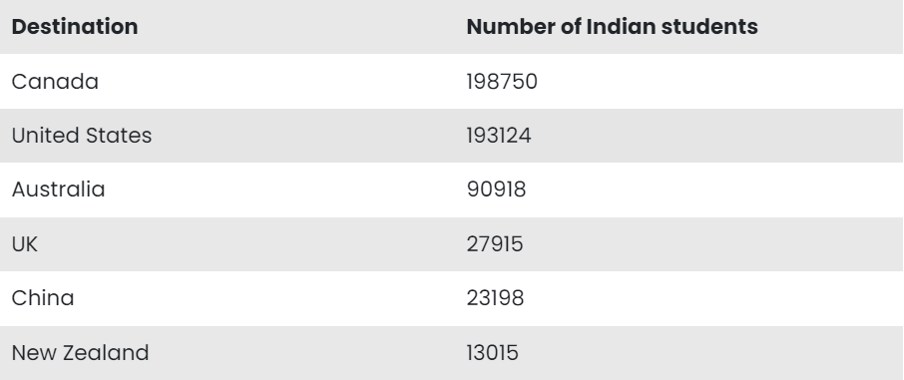
According to a RedSeer report, this number is expected to drastically increase. The report estimated that 2 million Indian students will be studying abroad by 2024, and 1.8 million Indians will be spending US $85 billion on education overseas by the same year.
With a heavy influx of students coming aboard, it is interesting to see where they come from within India.

According to the data, students are migrating abroad for their studies from:
• Andhra Pradesh (12%)
• Punjab (12%)
• Maharashtra (11%)
• Gujarat (8%)
• Tamil Nadu (7%)
• Karnataka (5%)
These states mentioned above are among the wealthiest in India, with a high awareness of the prosperity and benefits of foreign education. However, with the development of digital technology, many states, such as Punjab, are paving the way for online education sharing, which allows Indian Punjabi students to stay in India while also receiving a foreign education.
Indian Ambassador to the United States Taranjit Singh Sandhu said, “Students can now explore opportunities online and take foreign courses while sitting in India. The new education policy is allowing campus-to-campus relations, and students can have intertwining degrees and joint research works”.
While education and knowledge are both readily accessible today, many students continue to go abroad to experience not only foreign education but the history, culture and language of the countries they migrate to.
Bithi said, “Australia ticked off four crucial criteria for choosing a country to pursue my studies, including world-class education, exposure to diverse cultures, weather, and post-study work opportunities”.
That being said, the number of international students studying Australian courses totalled 546,678 for the January-February 2023 period. This was a change of 26% compared to the same period last year.
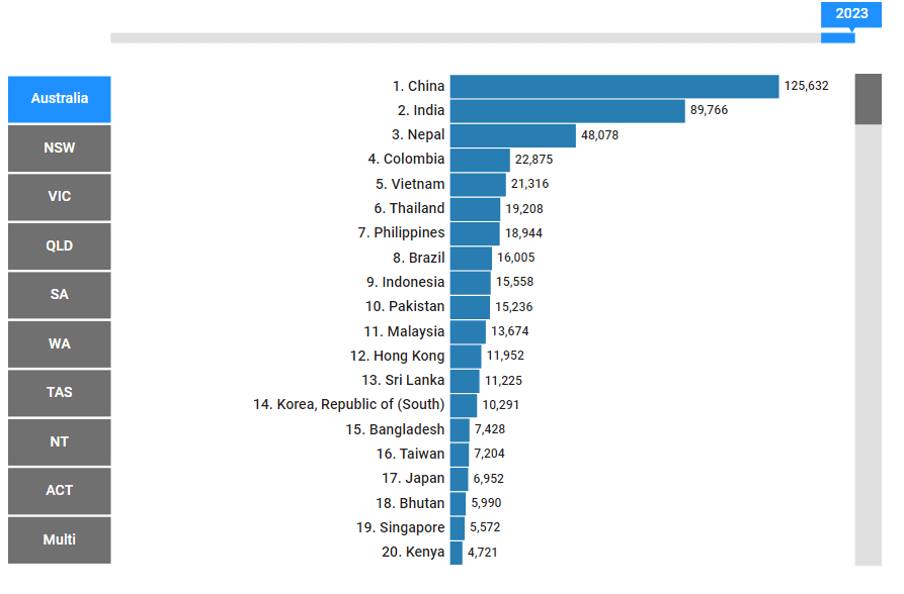
According to the Department of Education, nearly 90,000 students from a total of over 540,000 students are from India. Indian students find it relatively easy to adjust to Australia as there is a broad range of Australian universities and educational institutions that a student can choose from, which can meet their unique requirements and ambitions. However, some students find it difficult to study in Australia.
Rahul Bhardawaj, a former international student, said, “The Australian and Indian education systems are very different. Indian education is more theoretical and concept-oriented, which builds a strong knowledge base. Whereas the Australian education prepares us for the real work we would do later, and is more application based.”
Even though Rahul had to adapt to his new learning environment in Australia, he said he would recommend anyone who had the opportunity to take it. “Few of us have this opportunity and are privileged to do so, and it helps build our overall personality and helps us learn life skills more than anything. If we learn to survive alone and make a living by paving our own pathways, it will boost our confidence as young individuals. It's all about getting out of the comfort zone, which is the only way to grow and progress.”
Stories like Rahul’s and Bithi’s motivate other Indian students to come and study in Australia. Due to this, Australia was on track to have the largest group of foreign students from India due to the deteriorating ties with China. However, in May 2023, Australian Universities placed restrictions and bans on Indian students amidst fraud concerns, including the University of Wollongong, Western Sydney University and Victoria University.
They claim this is due to alleged fraudulent submission documents and high rates of dropouts. Students from India are being accepted to universities in Australia yet are not attending classes as students are being lured into cheaper courses at various vocational institutes that lead to jobs and then permanent residency.
This ban has negative consequences as it prevents students who truly want to study in Australia from coming. This also places a huge uncertainty among parents, which reduces people’s preferences for Australia as an educational destination.
Studying abroad allows you to immerse yourself in a new culture and experience a way of life different from your own. Although the Australian ban on Indian students is temporary and uncertain, it cannot stop students from living and working towards their dreams.
Aiyesha Swarnn is a First Class History and International Relations graduate and has been working as a freelance writer for over two years, focusing on her passions for South Asian culture, climate and youth advocacy. You can find her on LinkedIn.