ਓ, ਧੀ ਸਰਦਾਰਾਂ ਦੀਆਂ ਜੁਰਅਤ ਵੀ ਪੂਰੀ ਐ (‘O dhee sardaara di ae jurt vi poori ae’) is the first lyric in the late Punjabi artist Sidhu Moosewala’s song titled Jatti Jeone Morh Wargi. While it is difficult to translate the true essence of the lyric to English, the rough translation is ‘the daughter of a Sardaar is equally as courageous/brave’. It asserts the strength of women is not only equal to that of a man, but complete and whole independent of external factors or influences.
This lyric is written on the back of the shirts of Melbourne’s first and only all girls bhangra team, Sherniyan, in the lead up to their first bhangra competition Bhangra Down Under.
Formed in 2018, the team is named after the punjabi word for ‘lioness’ and consists of girls from all over the city who come together to share their passion for bhangra with each other and the broader community. Sherniyan regularly performs at celebrations such as weddings, birthdays, and melas (festivals).
I was lucky enough to have a chance to sit down with the Sherniyan captains Baljot Atwal, Jasmeet Jandu, and Sifti Singh to hear their thoughts on leading an all girls team in a dance form which has traditionally be masculine, what goes into preparing for a bhangra competition, balancing the competing roles of being a friend and a team captain, and the future of bhangra.
History of bhangra
Bhangra originated in Punjab as a traditionally male folk dance performed by farmers to celebrate the harvest season. It’s a high energy dance form which encapsulates celebration - watching a bhangra performance you will undoubtedly feel joy as you see the brightly dressed dancers perform powerful moves to upbeat music. You will hear dhol (drum) beats and experience the dancers engaging with you through ‘nakhre’, flirtatious cheeky mannerisms that build a rapport between the dancer and a member of the audience.
As Punjabis migrated to the West, bhangra came along with us. In the 80s and 90s, the UK and North America began to see the emergence of what has now become competitive bhangra circuits, with the establishment of teams that competed in competitions organised by universities and independent organisers. Bhangra has now cemented itself as a core component of diaspora Punjabi identity.
Today, bhangra is performed by both men and women and with an increasing number of all girls teams entering competitive bhangra circuits globally traditional norms around the dance continue to be challenged.
Sherniyan aims to be just as strong and just as powerful on stage as their male competitors.
“This is something we actively think about, especially as we are preparing for a competition,” Baljot says. “We want the general community to see that girls can dance just as strong as the boys, that we can have that same intensity, the same power, and the same strength.”
Jasmeet adds that the team’s name reflects the kind of messages they want the team to tell. “We try to get all the girls in the team to be thinking about this and what story they want to tell when they’re on stage.”
Preparing a set
Bhangra Down Under, Australia’s largest bhangra competition, requires teams to perform for 7-10 minutes, then judges them on a framework set out in the competition rules.
Sifti emphasises the importance of being respectful in competitions and outlines how points can be deducted for certain things. “Once we are done with a prop we can’t chuck it to the side of the stage, we need to place it there. We can’t use our feet to touch anything we use, like even the cones we can’t move them around with our feet”
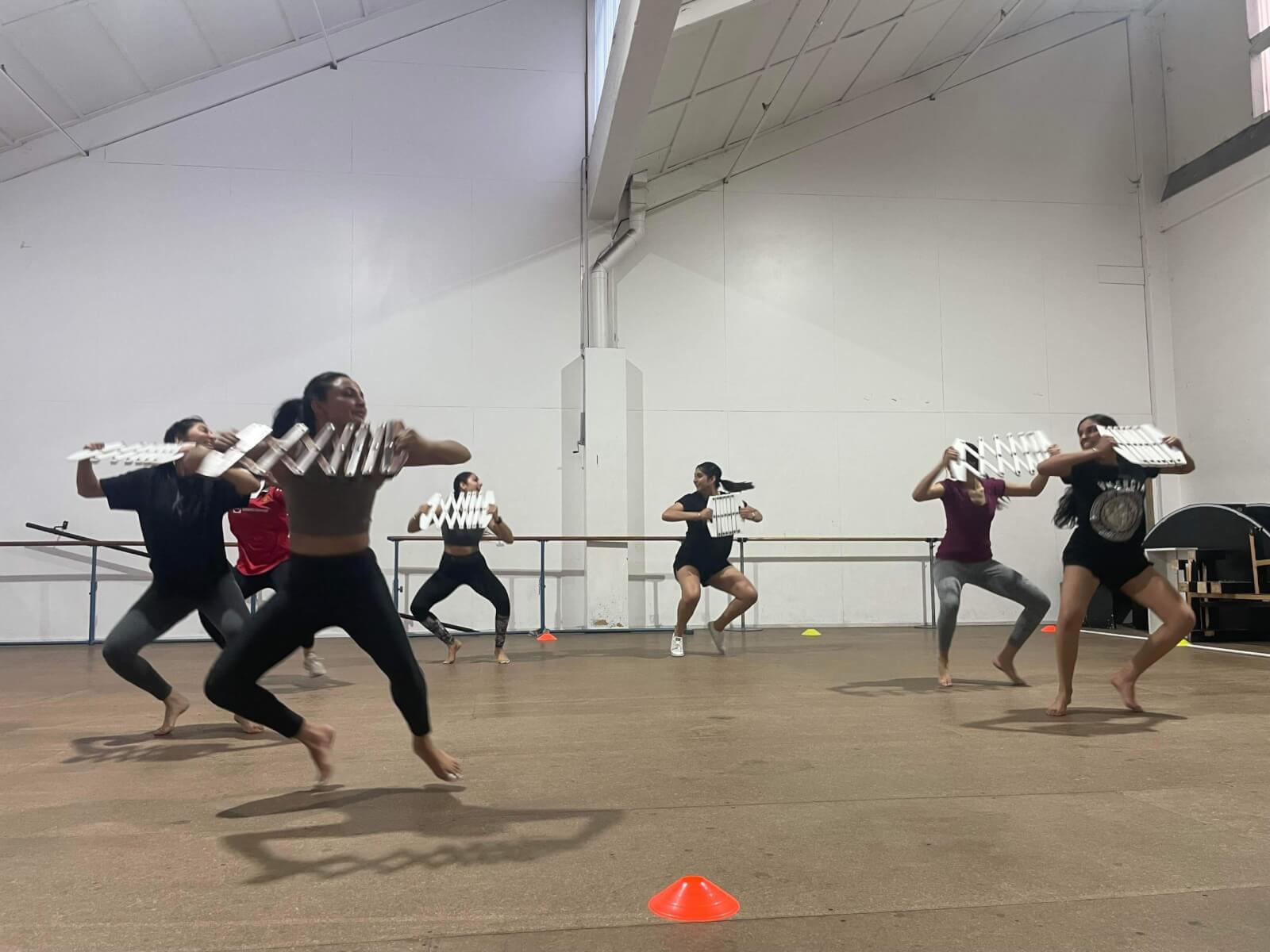
Sherniyan practicing their formations.
As long as the team addresses all the core requirements of the competition, they can showcase a lot of creativity in their routine.
“We do have a lot of flexibility in the way we structure [the routine],” Jasmeet explains. “Bhangra is a lot of fun and a lot of the songs we choose to include in our set are fun songs. We develop choreography to music that will make us enjoy ourselves on stage.”
Long hours
Preparing for a bhangra competition is a lot of work. A lot. At the moment, Sherniyan has competition training four days a week with training sessions typically being two hours long. Most of the team manages this on top of full time jobs or uni.
Led by the team captains, the team will learn new choreography and stage formations, and do multiple run throughs of existing choreography to refine it and build stamina. The session ends with the team at the point of exhaustion, huddled around a laptop or phone screen to watch run throughs and find points to improve on.
 Sometimes the team trains in studios with no air conditioning, so the laptop is always strategically placed in front of a fan.
But the work of the captains goes far beyond the hours spent at training, and a lot of it goes unseen.
When I asked the captains about what happens behind the scenes, they all looked at each other and laughed.
“It’s taking over our lives” Baljot says and the other two captains nod in agreement..
“You have to do a lot of research,” Sifti explains. “Watching hours and hours of videos of performances from teams you admire to get inspiration for types of choreography and music. We then get together to combine our ideas into a segment which could take three to four hours for about one minute of choreography, but those three to four hours of developing the choreography is built on like two days of watching videos to get the inspiration to get there.”
“It took us four hours the other day to figure out the formations to get two people of the same colour next to each other on stage,” Baljot adds, laughing.
Baljot also points to the back and forth between multiple studios when organising training times.
There are also the random fires that pop up, which the captains have to find a way to put out. The previous week, they were ghosted by the DJ who was putting their set together for BDU, and now they have to find a new one at the last minute.
“We divide the tasks between the three of us,” Jasmeet says. “Having three captains is a lot better than just having one.”
Getting recognition
While Bhangra Down Under is Sherniyan’s first bhangra competition, a huge moment for the team was winning the annual dance competition run by the Indian Film Festival Melbourne in August 2022.
Baljot tears up a bit as she explains how special winning the competition was to her. “We had been a team for a number of years and in those years we had worked up to preparing for a competition multiple times but things kept happening that prevented us from actually competing, COVID mainly.
“After we heard we had won we did paath [a Sikh prayer] and we cried for half an hour straight. We were all really emotional.”
Jasmeet says the feedback the team got from other teams in the circuit really gave her confidence in Sherniyan’s abilities and her role as a captain. “Winning wasn’t even something we had considered. Afterwards, we had people from other teams that we looked up to messaging us, and that was really exciting… it was the first time it hit us that, ‘Hey, we’re actually kinda good.’”
“Our group chat afterwards was crazy,” Sifti adds.
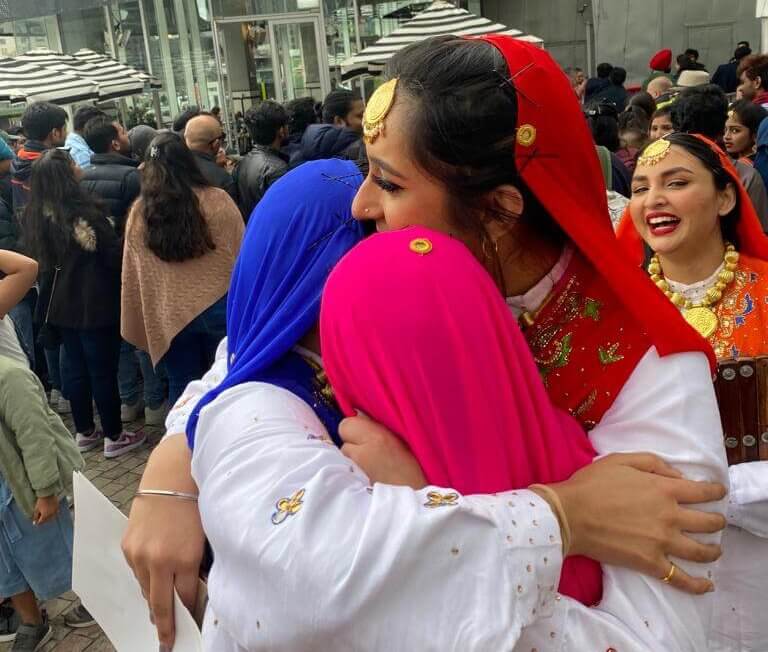
The team embracing after winning the IFFM dance competition.
Creating a team culture
Sherniyan’s team spirit is undeniably strong, and it is most apparent as the team prepares for a competition. For a group of girls to turn up to training week in week out, despite competing priorities, they have to feel as though they are a part of something bigger than themselves and are working towards something larger than themselves.
Training is high energy, but the environment is incredibly supportive. Even in times of high pressure, as the team prepares for competition, you can feel the team in ‘chardi kala’ (positive spirits) as they work towards a common goal. Despite being exhausted during run throughs, the team yells words of encouragement to each other as they dance to keep the energy up.
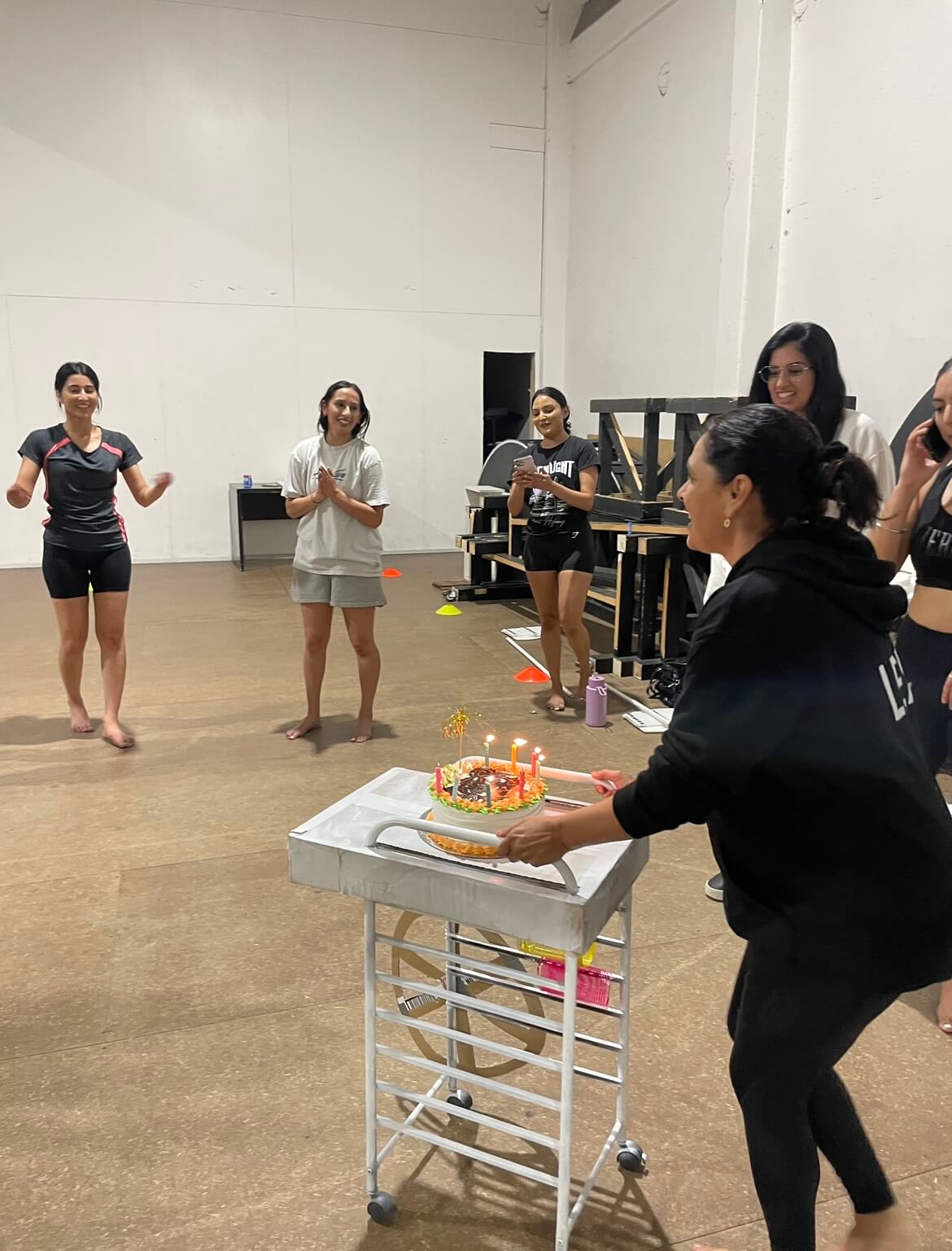
Spirits are lifted when the team surprises one of the team members for their birthday with a cake from Khalsa Bakery bearing the Sherniyan logo.
While the captains all acknowledge that it helps that the team members are all friends, Sifti points out that team cohesion also takes work to maintain.
“We are friends with all of the team – that comes with the benefits of the team being cohesive and everyone being happy,” she explains. “But it also becomes hard, because as captains, we have two roles we need to play – we have the relationship of a friend, but then we also have the leadership relationship of a captain. At times it's hard because these two relationships clash.”
Baljot agrees. “As captains, we have to have those difficult chats. We have to think of and prioritise the team, and make decisions for the team. Like if we are competing, instead of thinking for our friend, we have to think on the level of the team.”
“For the team members to understand that and take that on board maturely really helps,” Sifti adds. “It’s not just the captains but it’s all the team members as well who contribute to the positive environment. Everyone keeps the team’s best interests in mind.”

The team applying make-up on each other ahead of a performance.
The future of bhangra
As the competitive bhangra circuit continues to develop in the West, teams are becoming increasingly innovative with their routines - from music choices to the incorporation of non-bhangra dance moves to the addition of gimmicks. With this innovation there have been concerns that bhangra is moving away from its traditional roots and is becoming westernised.
‘I always think about this!’ Jasmeet says. “I think it’s really cool to have fusion in bhangra, but I get concerned when it comes to the way it’s taught. I think if you teach bhangra in a traditional way - like you teach the moves without diluting or westernising them and refer to them by their Punjabi names - then it can be fun to add in elements of hip hop music to the mix you’re performing to. But I think the issue arises when bhangra is taught incorrectly in a Westernised way and the dance moves are impacted.
“Fusion is good, I love fusion, but if you’re going to be teaching the moves it has to be the correct form in the traditional way.”
“When you look at today’s generation and what they listen to, sometimes it becomes inevitable,” says Sifti. “When you get innovative with the beats and music you do it to, [Bhangra] does look cool… It is a balance though, you need to use hip hop music and beats in moderation.”
Bhangra Down Under is being held on Sunday 12 March from 1pm-6pm at Bunjil Place in Melbourne’s East. General entry tickets can be purchased for $50.
Sukhmani Randhawa has a degree in economics and philosophy and currently works in Energy Policy. Despite this, she herself barely has energy due to her iron deficiency.