I am an immigrant; I fit in politely, but I belong nowhere. I am everything disgraceful about my culture and country, and simultaneously everything captivating about it.
In his 1991 essay Imaginary Homelands, Salman Rushdie compares literature on the diaspora, and argues that the migrant ‘is, perhaps, the central or defining figure of the twentieth century.’
On the 20th of February 2023, I became a permanent resident of Australia. A few weeks later I received my green medicare card in the post, the word ‘interim’ symbolically no longer printed on it. I went out, celebrated with friends, but all I really wanted was to have a quiet dinner with my family back in Malaysia. Only they knew intimately the struggles I went through in my journey to obtaining permanent residency, including being rejected for numerous jobs I was qualified for simply due to my residency status.
Grief and happiness churned inside me. These mixed feelings were an ambivalence I’ve repressed as an immigrant here.
Diaspora populations teach us what it means to be human, Rusdie continues in Imaginary Homelands, because they lose the defining parts of their humanity: what makes them human, namely roots, culture and social knowledge; giving rise to the critical question, ‘How are we to live in this world?’
For years I desperately wanted Australia to let me stay, but I ignored the fact that I have never felt at home here; even when I finally had the Aussie greeting down pat, and had a community of friends I could call my good mates.
I didn’t feel at home, when I struggled to land a job after graduation, and through some experimentation found to my horror that shortening my surname to a more Anglo-sounding one in my resume increased the odds of being contacted.
Something gnawed inside me when I would prepare one of my favorite childhood dishes — a speciality of the Chettinad region of Tamil Nadu — for my Australian ex-partner, and whilst tucking in with silver cutlery, they would offhandedly comment that it was ‘strange watching me eat with my hands’.
I have lived in denial of this ambivalence, fearing it being unwanted in my country of origin, where I would be considered one of the ‘lucky ones’, and unbecoming here, where I might be told to ‘go back home’.
I was here with the sole purpose of making a better life for myself, better than the one I would have back in Malaysia, where unfortunately discrimination is embedded in law.
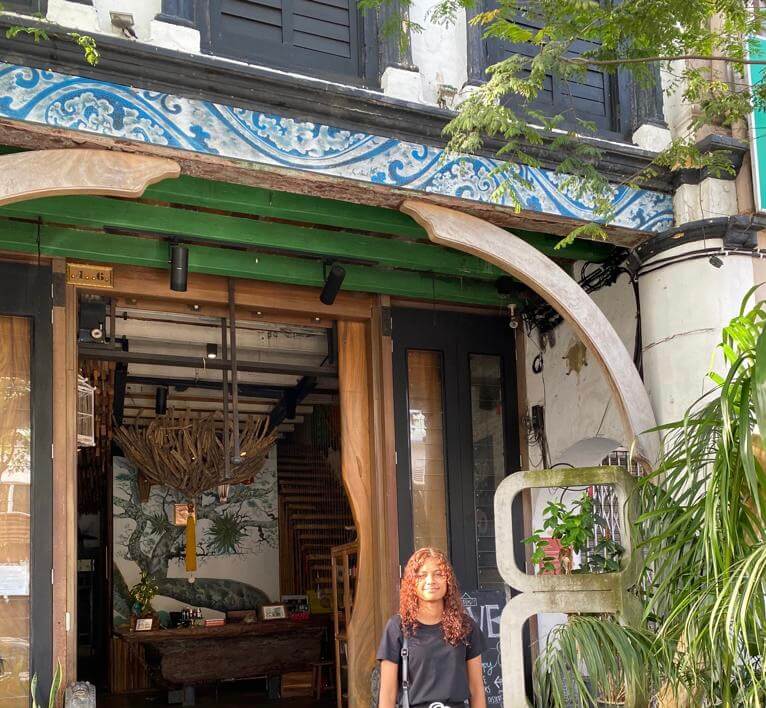
Davinia in Ipoh, on her most recent trip back "home".
As a part of the ethnic Indian minority in Malaysia, I was affected by institutionalized racism towards minority non-Malay populations. This meant for me, amongst other things, educational scholarships and government positions were harder to obtain, and a higher tax rate as a non-Malay. I wanted to stay in Australia at all costs and thrive, but realised the true cost much later.
The cost of a birth country that has moved on without you, over the years you were assimilating in Australia; the lost familiarity of things left behind. The last time I was back in Malaysia, I realised I am as at “home” there as I am here in Australia. Home is now a construct — and that is the ultimate price I paid.
Last year in Malaysia, my parents moved out of the house I grew up in; a house built the same year I was born, and while they mourned this, I was indifferent, and both ashamed and surprised at this apathy.
My birth country is no longer my home, and each time I visit Malaysia this sentiment hardens. For me, this painful drifting from my home country is somehow akin to a break up. This might seem like an exaggeration, until we consider the research surrounding trauma, nostalgia and mourning in the immigration experience.
Published in the The American Journal of Psychoanalysis, the article Social trauma, nostalgia and mourning in the immigration experience, says there is trauma associated with the separation from the ‘mother’ and ‘mother country’, marked by a loss of continuity of familiar places and people.
The losses form a component in nostalgia commonly felt by immigrants, along with joy and gratitude, underlining the complexity of this emotion. It's also important to consider that not all immigrants experience this trauma and/or nostalgia immediately, and some may never view their immigrating with a lens of loss.
Understanding immigration as a potentially traumatic event explains my turmoil, ambivalence and lack of belonging. It sheds light on the higher possibility of trauma felt when leaving your home country, as is the case with refugees.
A week after obtaining my permanent residency, I visited Uluru, and met the traditional owners of the land there, the Anangu people. I was advised by my guide as per the wishes of the Anangu people, at the cultural center, to let the knowledge of the Tjukurpa (their traditional law, stories and spirituality) I hear to ‘come through my ears, into my mind, and settle in my heart’.
I found this to be especially affecting in a world where we often make sense of differing truths and realities without taking into account the innate humanity we all possess.
As I was leaving Uluru, I stared at the red earth and acknowledged the ache of wanting to be anchored securely somewhere, quieten. As a visitor, I now carried a sense of the connection the Anangu people felt to their lands, and this comforted me greatly in my new home land.
Davinia Gunasagran is a product analyst at MYOB and a Startmate's Women Fellow, you can connect with her on Linkedin here. In her spare time she enjoys reading, writing, running and travelling.