“Language, identity, place, home: these are all of a piece – just different elements of belonging and not-belonging.”
- Jhumpa Lahiri
Does your home reflect your well-being and inner-self?
During COVID, we realised our homes deeply affect our wellbeing.
Our home is the literal container for our lives, memories, and a mirror of one’s inner self.
There are few words more as laden with meaning as the word home, particularly if you are an immigrant.
For us, there are multiple ideas of “home” simultaneously – one of birth, one of choice as migrants or, for a second generation, one of descent. When I hear the word home, I remember sipping chai on a roof terrace or balcony, full of colourful details or textures, and being surrounded with conversations and laughter.
But too often, as migrants, we find our homes in Australia fall into a pre-existing mold. There is an emptiness that affects how we live in these cookie-cutter spaces.
I’m one of the few senior South Asian architects in Australia, and I’ve seen it over and over: Our home designs don’t reflect who we are and our South Asian culture.
Why does housing in Australia fall short for the South Asian diaspora?
Other immigrant communities – Chinese, Italian and Greek to name a few – have long been re-shaping their Australian homes to reflect memories of their homeland and to reconnect with culture.
But no one is reflecting on this idea. The idea that shaping our space can reflect our culture and contribute in positive ways.
“While the immigrant contribution to nation-building (in Australia) in cultural terms is well-known,” say the authors of Immigrant Industry Building Post-war Australia, “Its everyday spatial, architectural and landscape transformations remain unexamined.”
This is reflected in the physical houses we have the opportunity to buy. Once we have the ability to buy property or own a home, the desire to see one’s culture in that home rises to another level.
Most existing housing stock in Australia has a template based on settler-colonial values, a nuclear-family focus and is poorly suited to the local climate. It is no surprise that cultures who have very different values and family structures find these dwellings a poor cultural fit.
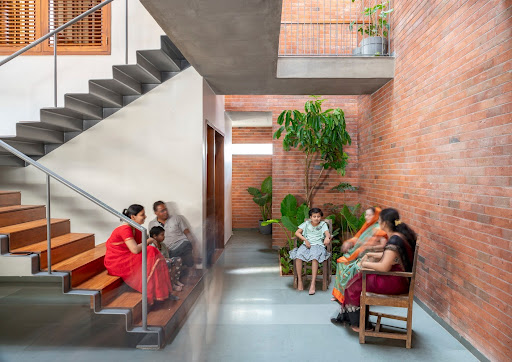
Intergenerational family ties and family visitors who often stay for a few months is a common reality of the South Asian diaspora. Image: A Dialogue with the Past house by A Threshold, India; Photographer: Atik Bheda
Sanskiriti Mehta, a second-generation South Asian migrant, echoes this sentiment. When she recently moved out of her childhood family home in Melbourne, the hunt for a new abode proved challenging:
“When you walk into a space, there is an energy. It is about being able to picture if the place feels like you. There were many spaces where I could not envision myself.
Layout matters. My childhood home was always the place where everyone would gather. For me, I need to walk in and have a clear sense of a communal area.
If the home does not encourage gathering, I don’t relate to it.”
The missing piece of the puzzle is to remember we have a powerful built legacy to tap into as South Asians, and that we shouldn’t accept just what we find if it doesn’t fit who we are.
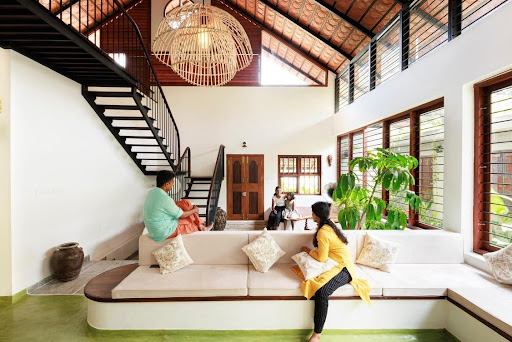
Spaces that facilitate multiple groups matter to the South Asian diaspora, many of whom grew up in multi-generational families from collectivist cultures. Image: Janani Residence by Naked Volume Architecture Studio, India ; Photographer: Abhimanyu KV
What is our built legacy as South Asians?
As an Architect and immigrant with roots in South Asia, I am constantly amazed by the breadth of our vast built legacy.
South Asia is incredibly diverse and so is its built legacy.
Its palette is incredibly rich – ranging from brick, terracotta, bamboo, timber, rammed earth and stone – and adapted to ecosystems including Himalayan high country, deserts, deltas, plateaus and tropical forests.
This legacy goes back millennia, as far back as 3000 BC, and is a living heritage that the act of migration cannot disconnect us from, except by our own choosing or our acquiescence to the status quo we see.
We often are told to, or claim to, ‘live our values’ but we don’t often see those cultural values reflected in our built spaces - the external and interior design of our homes.
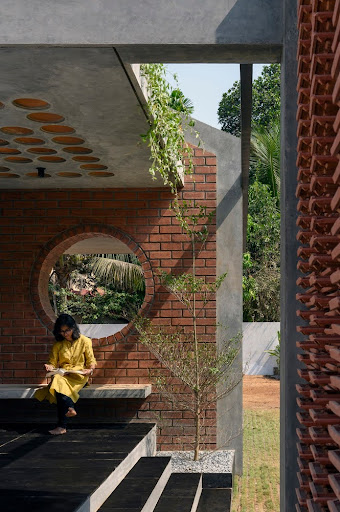
Image : Transposed Courtyard House by Studio MSA, India ; Photographer : Hemant Patil
For example, some of us may adopt the ideas of South Asian design from the Vaastu Shastra, a thousand year old system of rules that dictates how a house is laid out and designed.
But our built legacy is more than rules. It’s more than the Vaastu Shastra. And even if we like the ideas in the Vaastu, it is fundamentally meant for the northern hemisphere sub-tropics.
Vaastu Shastra is a poor tool to apply to the southern hemisphere’s sub-temperate region.
The only thing we should take from it is that getting the right solar orientation, natural ventilation, connection to nature and embracing texture matters more than following any specific rules slavishly and uncritically on the opposite side of the world.
What we often don’t have is a vocabulary of our own design. The images of what modern South Asian design looks like, so we can advocate for the inclusion of our legacy in our built homes.
- We can play with light and shade. Using unique South Asian ways to filter the harsh afternoon sun like jaalis (screens) or through mini-courtyards.
- We can embrace texture over neutrals. Cane instead of Leather, Stone or Terrazzo instead of bare concrete, exposed brick instead of render, warmer tones of cabinetry instead of Scandinavian ones.
- We can reconnect to our playful love of colour through a vivid finish on a door or handrail.
- We can curate key ornamental details, of which we have a proud tradition.

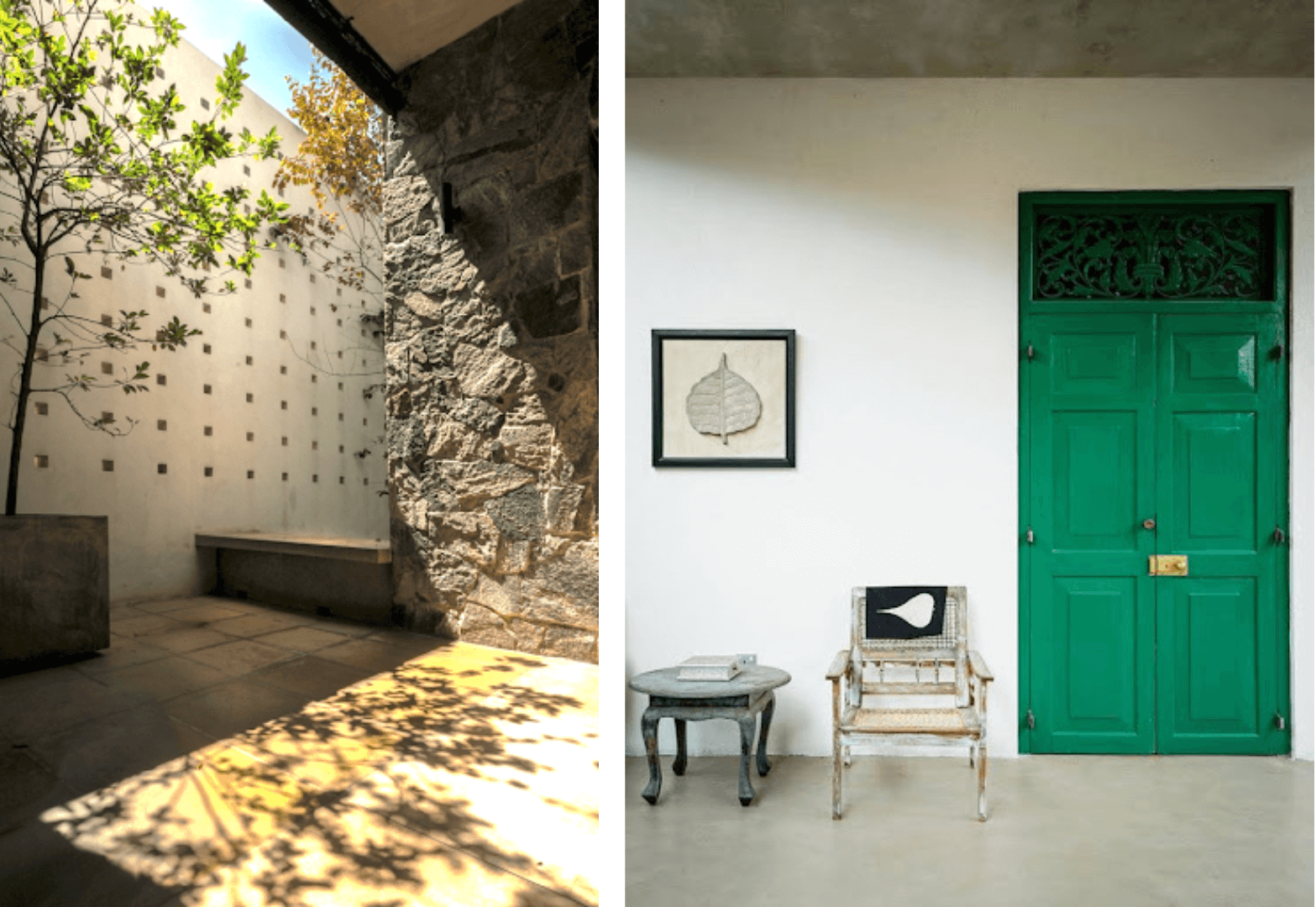
(Left) 'Urban Envelope' Samuel House by MMGS Architects , Sri Lanka ; Photographer- Malaka Weligodapola. (Right) The “cul-de-sac” Residence by Chathurika Kulasinghe, Sri Lanka ; Photographer - Ramitha Watareka]
But it’s not always easy in Australia to bring in these and other South Asian elements.
Gauri Vohra, a first-generation South Asian migrant and co-founder of Original Chai Co, voices her frustration in trying to connect with this legacy during the recent process of renovating her home in the northern suburbs of Melbourne.
“Although I want our home to look modern, I really wanted to bring in key elements of our culture. The process of sourcing furniture, choosing finishes and commissioning joinery to achieve this was very stressful and exhausting. We didn’t like 90% of the available options, and as a customer you get so distracted by the typical things that are available in the market.
You become absolutely overwhelmed. I think a clear understanding of what culturally resonates with you first is very important before you go out there.”
To overcome these challenges, the best approach is to create a ‘cultural brief’ for a designer.
What is a Cultural Brief?
The most powerful way to reclaim connection to culture is through personal memory and the haptic senses.
A cultural brief translates those into specific outcomes you want to see in your home, to make it yours. It is part of the process to achieve that reclamation.
A cultural brief is not about big features, it’s about the little things.
Look closer to Home. Expressing a personal legacy is the most meaningful connection the South Asian Diaspora can create to reclaim the slippery notion of “Home”. To start, reflect on your connection to culture.
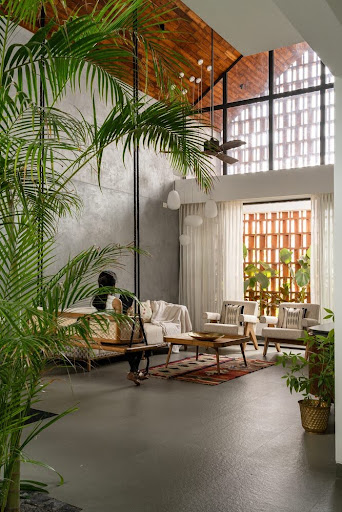
Image: The Ridge House by Enviarch Studio, Bengaluru. Photographer : Yash R Jain
If you’re a first-generation immigrant…..
- What was your childhood home like?
- What was your neighbourhood like?
- What do you remember most about your hometown?
If you are second-generation immigrant…
- What is your family home here like?
- What were your grandparents / extended relatives’ homes like?
- What places have you revisited as an adult and felt a connection to?
As you put together a cultural brief, here are some detailed questions that can help. These are the questions I ask my South Asian clients:
- Which space(s) did you feel comforted in? Or connect happy memories to?
- What materials, textures and colours did you see around you?
- How did your body occupy the space? What varied postures could you opt for?
- How did light filter into those spaces?
- What was the connection to the outdoors like?
- What everyday rituals did you find joy in, and did they have a spatial dimension? (Chai on a roof terrace? Chatting with neighbours on a Verandah? Prayers in the Courtyard?)
Keep these answers front of mind when sourcing items or when explaining what you want to achieve to a design professional, local tradesperson, or builder.
Most designers here have very little exposure to South Asian architecture, and especially not to contemporary South Asian architecture, so relying on the typical providers means they are not going to be able to fulfill this very deep-seated desire to make our homes here our own.
Gauri notes the changes that can happen when that Cultural Brief is clearly communicated and understood:
Once you know what you want, do not go in with the idea that the builder or tradesperson is going to figure things out for you. You really need to go with a clear brief of what you would like them to do.
It takes putting your foot down and explaining that there is a deeper significance and meaning for them to finally “get it”.
Then things really change, and they start to steer towards what you genuinely like and the spaces and details seem to change, and it starts to embody that cultural connection.”
It’s important to remember that the process of creating a cultural brief and the outcomes you are seeking are not just interior styling recommendations like a traditional painting or cushion covers.
What you really want to do is embody culture into your space on a deeper level.
Gauri reflects on this :
There is (also) the mindset that has internalised the message that unless something is trending on Instagram here, it is uncool. However, there's so much contemporary design in South Asia. We sometimes seem to lack that self-belief.
When we value that cultural connection, it’s easy to make that trade off against something else in the home that matters less.
And for me, when I designed my own home, that cultural connection was something I prioritised and deeply cared about.
How I embody culture in my own home.
All of this is personal to me as a South Asian architect in Australia.
When I had the opportunity to renovate and extend our home in Melbourne, we sat down to nut out what our Cultural Brief would be.
We instinctively agreed that exposed Brick would play a big role. We had many vivid memories of it from home and hometowns and knew how versatile brick can be - as wall, screen and even ornament. So naturally, we had to use it in Jali form for the west-facing dining room window, filtering the harsh afternoon light beautifully without making the room hot.
As the sun sets, the light and shadow play across the table, floor and finally the wall opposite- triggering happy memories of lazy summers spent at our grandparents’ home and using shadows like a sundial to guess the time of day (something I now do here). This tiny element brings us joy every day at golden hour.
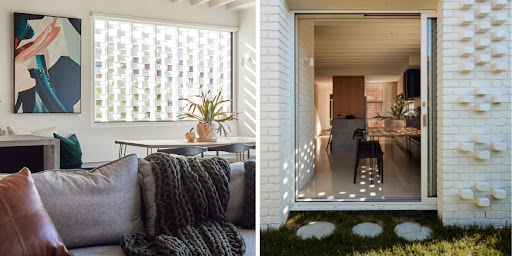
Architecture & Interiors by andever. Photographer: Peter Bennetts
Modern design has sadly diluted our ability to appreciate intricacy and ornament, which is a big part of our heritage. It is in our textiles, jewellery, handicrafts and buildings. The beautiful Art-deco ornamental details in the existing home here really resonated with us.
I had a chat with the brick-layer on-site about this part of our cultural brief. At first, he suggested a modest projection. When I explained our design intent, ornamental tradition and shared South Asian brick designs, we collaboratively came up with a solution to maximize projection.
The corbelled bricks have now become a living artwork whose shadow changes with the afternoon sun and our neighbours even thanked us for creating an ‘artwork’ they enjoy seeing everyday.
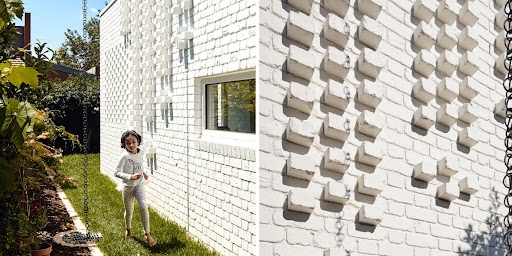
Architecture & Interiors by andever. Photographer: Peter Bennetts
Wherever possible we wanted to introduce texture - choosing masala over bland. We recreated the ubiquitous vibrant “mosaic” floors of our childhoods.
I curated a custom aggregate mix for the polished slab topping that included warm green and orange tones (the only colour options available) vs the typical plain grey or black aggregate. The jewel-like tones it adds often draw exclamations from South Asian friends and family who instantly make the connection too.
At our relatives’ homes, the most popular seat was never the sofa. It was the divan/takht/daybed. We cousins would pile on and sit comfortably cross-legged.
This was something we really wanted to embody in the space for our kids.
Most daybeds/window seats here are typically shallow and meant for 1 person. We designed it to have twice the depth and to accommodate more people. The cabinet-maker eventually agreed to add reinforcements to the storage below to make the depth work, conceding that it was a more useful option.
This is where our kids now comfortably sit cross-legged to read, play carrom or fight over monopoly. Sitting in this way now feels natural to them and is instinctive.
This is where I now sit cross-legged and have my ritual Sunday chai with a newspaper spread out before me - a ritual that connects me to my grandparents and parents. Finally we carefully selected a vibrant and warm timber-veneer for the cabinetry to amp up texture and counter the white walls.
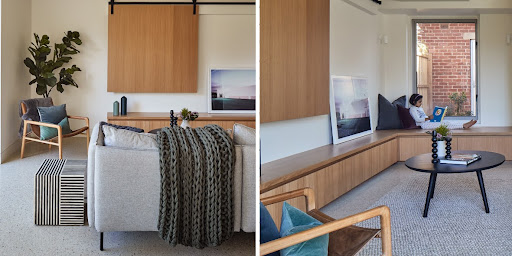
Architecture & Interiors by andever. Photographer: Peter Bennetts
My examples come from being a first generation migrant to Australia. But I’m heartened to see the desire to find expression in the next generation of Australia-raised South Asians too.
Sanskriti embodies this new generation, as a young psychologist who reclaimed her new apartment space, sharing the details that evoke culture for her:
We didn't buy a couch for our place in the end. We have a very large daybed, like a divan instead. And we find it's perfect for hosting friends and family even to this day. The ability to sit in different ways is so much more comfortable than any sofa we could find.
We also occasionally use these beautiful wooden low stools and eat, just the two of us, on the floor and eat from a thali. We call that feeling “tripti” (bliss). This wasn’t something I grew up with at all. But there is something so grounding about it.
I remember a lot of low-level seating from my Grandmother’s house. Even though her home was much bigger than mine, what I remember is the variety of seating depending on activity or conversation-group size.
When we take the step to embrace our design heritage in little ways, at whatever scale is within our means, we can find a sense of comfort that deepens how we see ourselves.
There is something so comforting when one wears traditional attire. It feels made for us and our bodies in a way that not everything else does.
The same can, and should, apply to our homes.
Sonia Sarangi is an architect based in Melboure. She is a director at Andever and Chair of the Board at ArchiTeam, a Not-for-Profit Co-operative & Member-based association for Australian architects working in small and emerging practices.