In order to be born, each of us needed to have 128 5th-great-grandparents who walked before us.
For those of us who are South Asian migrants to Australia, our family who walked before us paved our legacy. Sometimes they’re far away. That distance makes us crave the feeling of home.
This craving can take many forms. Food, music, dance, art, movies, jokes. We take each of these to connect with our culture, to share in our rhythms and references.
One unique way Indian people create home is using their tactile senses - with fabric. With saris and lehengas, shawls and embroidery, homemade wall-mounted tapestries and holy plain tablecloths for our home pooja prayer areas. We wrap ourselves with fabrics we hand down in our families, connecting with the generations who paved our way.
Melbourne Museum’s newest exhibition Sutr Santati is a weave of the cultural threads that bring us together. Within 75 pieces of the most masterful textiles, including a sari made an inch at a time over 4 years, it spins stories and evokes history, artistry, creativity and a sense of nostalgic home. It speaks to a Gandhian home-spun destiny that saw India make its own cloth a symbol of freedom.
Sutr Santati means ‘continuity of thread.’ 75 years on from our struggles for independence, India is on the rise to embrace the promise of that simple thread with an explosion of craftsmanship, a reclamation of dying traditional forms of textile creations, and a rainbow cornucopia of high-fashion couture the likes of which were recently on display by Dior at the Gateway of India in Mumbai.
Sutr Santati mirrors this journey of India coming to its own around the world through its artists and the pulse of the diaspora. The exhibition brings these unique and masterful textile artworks and designs out of India for the first time. It’s a delight and an homage, and walking through it provokes a deep cultural resonance.

Image: Chandravali by artist Vinay Narkar
Sutr Santati is on at the Melbourne Museum until 3 September, and it is truly worth experiencing.
The exhibition is curated by Lavina Baldota and brings together works from many prominent artists including a few who visited Melbourne for the opening, including Abishek Ganesh aka Kaimurai, Purvi Doshi, Gaurang Shah, Paresh Patel, Samira Shah and Manish Saksena.
Their works span a range of unique styles and give the viewer examples of abstract, religious, military, high couture fashion, and many different designs and weaving techniques, including rare and revived techniques, from across the 28 states of India.
SAARI Collective attended the launch of the exhibition, and we were able to capture the stories of some of these incredible artists.
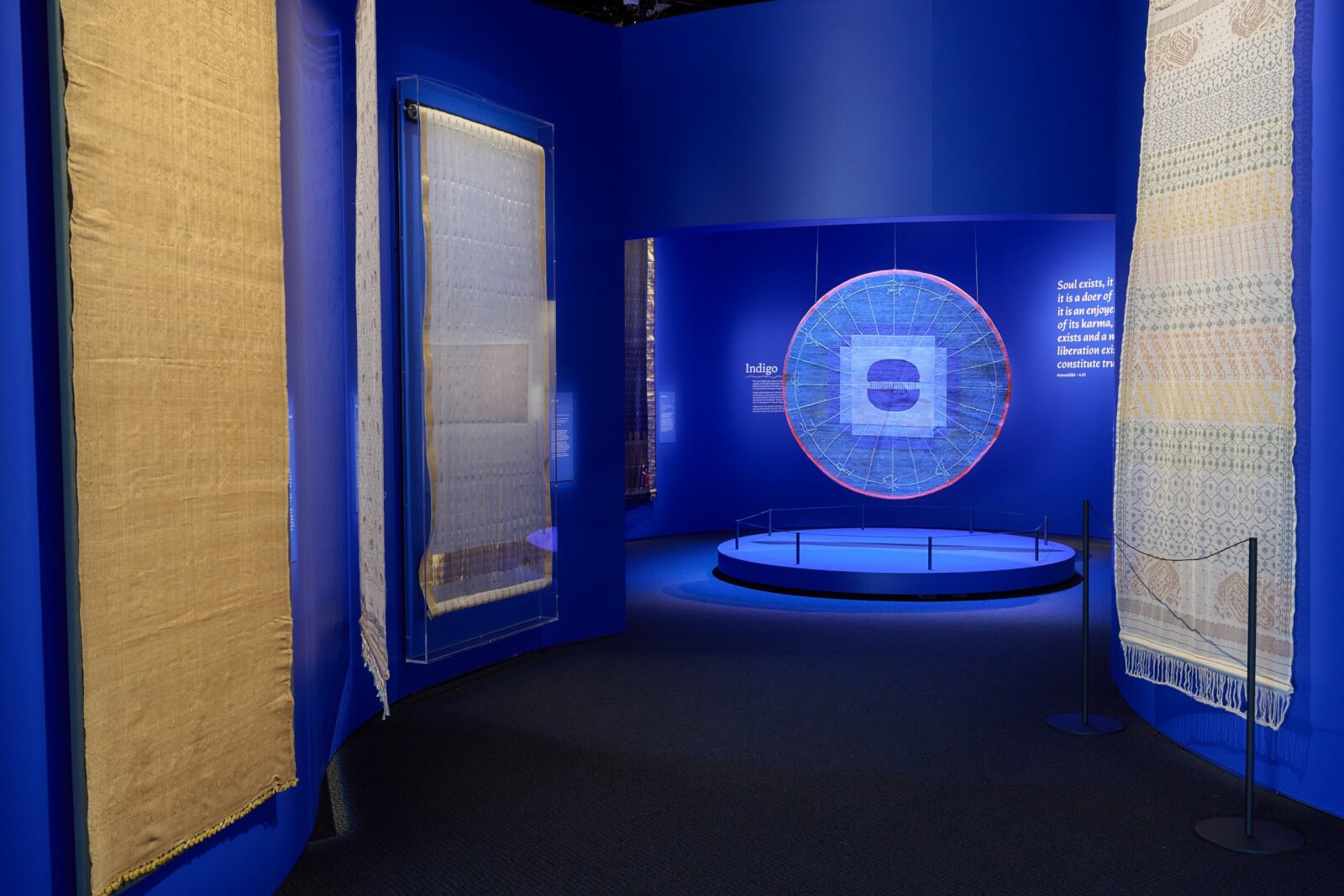
Abishek Ganesh aka Kaimurai: Rebellious Indigo
“Indigo is a rebel of a dye. It holds to the fibre, taking care of it like a baby.”
Like indigo, Abishek Ganesh is a rebellious spirit. He worked up the corporate ladder until he was the head of design at a high-fashion label. But he saw his corporate work as “designing to requirements,” not designing as an artist.
“I was working to solve problems instead of real creation.”
He’s an exemplar for the avenues that serendipitously open when one commits to an artist’s journey.
“I never set out to be an artist. I loved indigo and handmade fabrics. I travelled to weavers and met them. I started trying mark-making techniques like shading. One thing led to another.”
“It felt like I was returning to my childhood after 30 years,” he shares.
A self-confessed indigo obsessive, Abishek goes by the artist moniker Kaimurai, one he has been using for the past four years. Kaimurai means ‘method of hand’ in Tamil.
“My name Kaimurai is an ode to the weavers and dyers that are never mentioned in the creation process.”
India is the world’s largest exporter of indigo. The dye even gets its name from India. But while indigo is ancient, it is without a clear origin. Abhishek found the history of indigo to be a powerful story. He describes how Egyptian mummies were bound with indigo, and how it connects Indian history from its ancient past, to its colonial era, to the freedom movement and now to its place as a global powerhouse.
“Though it is not native to India, as we can’t claim it, Indians figured out how to transport it and bring it to the world, and it became part of our colonial history, and then became a part of why the freedom movement started in India.”
“Now our indigo is the most sought-after in the world.”
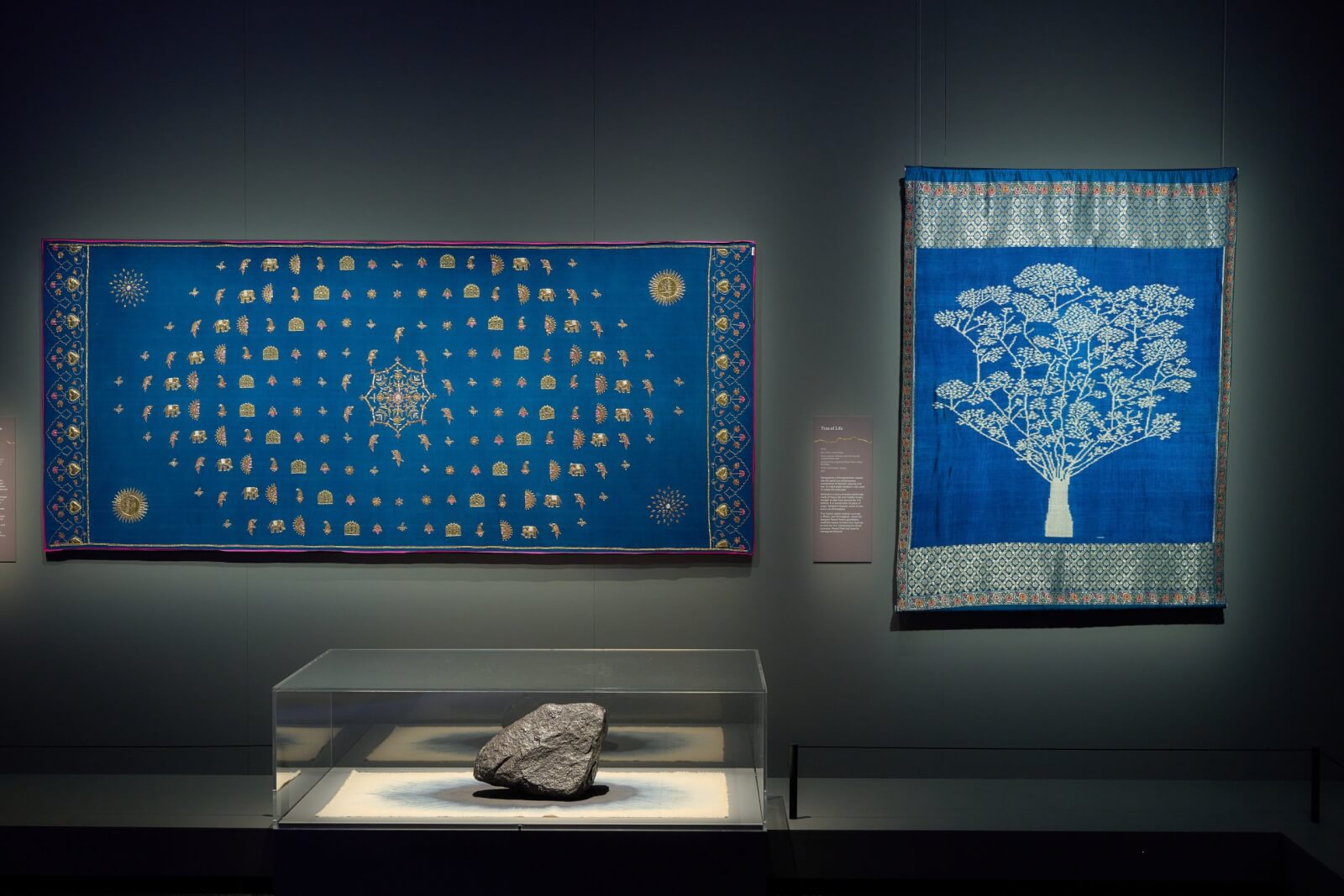
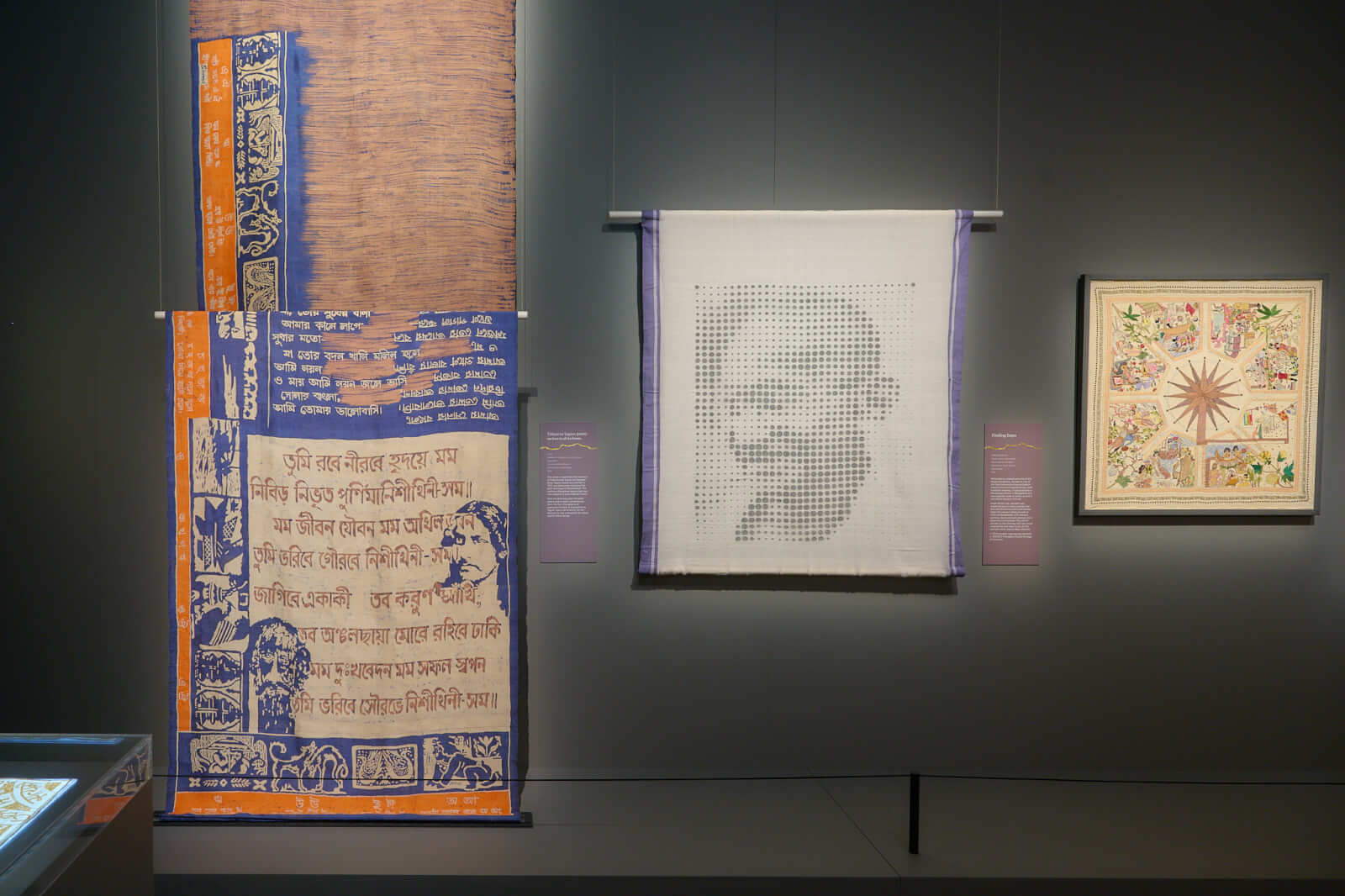
Image: Sutr Santati art work of Abishek Ganesh (lower) and other artists (on walls)
For Sutr Santati, Abishek used sophisticated techniques to create a signature piece of art, combining fabric, dye and stone.
“First I wet the fabric, then I pour indigo over it,” he describes.
“The fabric is made by weaves, with lines, and is like a shadow with indigo dye.”
“The stone in my exhibition is the natural world, painted with indigo. The indigo connects both - the natural and the manmade.”
The striking piece is also an ode to his father, a musician who built Abhishek’s connection to Carnatic music, and to his mentor Kulin Maniar, the Founder of the Bhavyata Foundation.
“The music inspires me in my artwork,” says Abishek, reflecting on how different art forms, both the tangible and intangible, connect and interweave.
It’s a metaphor for the invisible ties of history to the blue hues of indigo, and how we can continue to be inspired by listening to the voice of creative rebellion in ourselves.
Gaurang Shah: The 4-Year Long Sari
“My father ran a store,” says artist Gaurang Shah, speaking about the 5,000 year history of textiles in India, the largest producer of cotton and jute in the world.
“They repeated the traditional designs often.”
Like any good creative artist, Gaurang wanted to put his own take on tradition, and create more unique, innovative designs. After working in his father’s textiles store for many years, in 2001 he began studying looms and techniques.
He found inspiration in the embroidery in prints and architecture, in the curve of Mughal palaces and jaalis, the latticework of the Meenakshi temple, in the shapes and forms of the natural world in Madras near Chennai where animal motifs were incorporated into saris, but also global influences like Turkish tiles.
He drew on different techniques like Jamdhani from Dhaka in Bangladesh, Ikat from Odisha and the silk saris of Patan Patola from Gujarat.
“No one has ever recreated the Taj Mahal in fabric,” he notes, his eyes twinkling at the challenge.

Image: Patan Shrinathji, Gaurang Shah. Photo by Tim Carrafa.
Gaurang’s saris are the Rolls Royce of fabric, made by hand over years.
“For a 6 metre sari, I make the whole drawing of 6 metres, I dye the yarn, setup the loom, and start the weaving. I use 240 threads of colour I like, and the whole process takes at least two years.”
One of his saris in the exhibition was made over 4 years, inches at a time.
But what happens if he makes a mistake?
“I can’t undo it. I have to be patient and perfect,” he says.
“It is therapy. It is spiritual. It can be 1 inch per day, but you can see the emotions within the weaving. A husband and wife, a father and son, they can sit at a loom. They don’t talk, but they pour out their emotions into the weave.”
“If they are angry, the weave is tighter. If they are happy, the weave is good and relaxed.”
Gaurang Shah is relaxed in the moment, as he shows a video of his techniques. His understated brilliance and patience are tangible in his presence. His firm hands contain mastery and restraint in equal measure, and it’s obvious we are the presence of a master artist.

Samira Shah: teaching techniques with stories of the everyday
Samira Shah speaks to pieces that capture the life of many everyday Indians, with resonant themes.
“In the Gujarat earthquake in 2001, the walls of Kutch, and many homes and galleries with notable paintings using the Kamangiri mural painting technique were lost. Only their remains were left, and the artists, who were disturbed.”
“I met the oldest remaining Kamangiri artist, who created her weaves in handwoven cotton.”
“I worked with Ms Dhirajben Shah to create this piece of performers, like you see on the streets of India.”
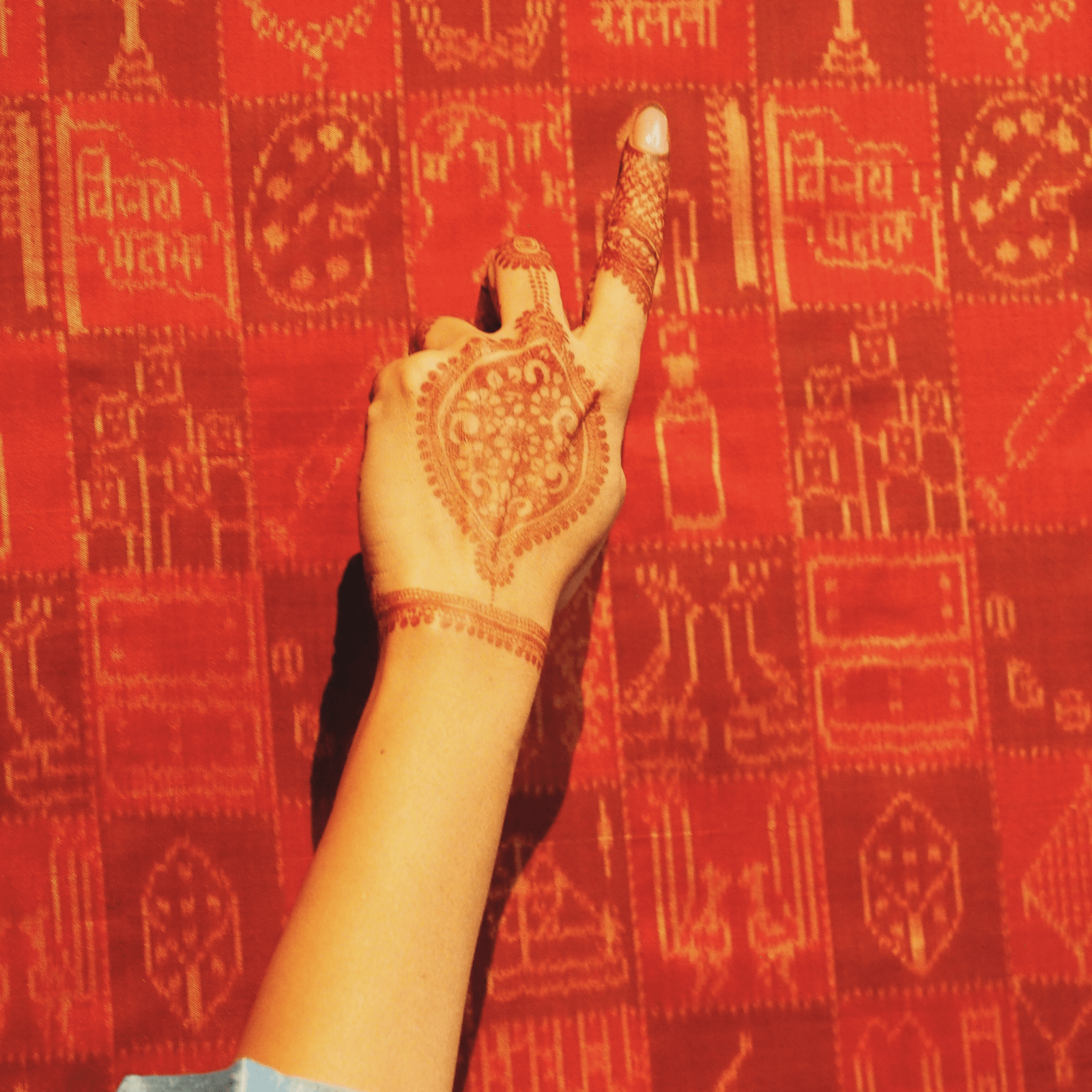
In her pieces for Sutr Santati, Samira also created a shawl made from an Indian army uniform.
“This type of shawl was given by the king to his warriors, as an honour. It uses camouflage and embroidery techniques from the north-east of India.”
Samira is the Founder and Director of the LeMark Institute of Art. She is known for advocating for the valuing of artists, for restorative work and reclamation of lost techniques.
“An artisan should never be left hungry, for they make art which is the food for our soul,” she says.

The Mumbai based LeMark Institute of Art focuses on fashion design, interior design and photography. As Samira directs the photographer at the Sutr Santati exhibition, it’s clear she has an eye for both design, contrast, light and imagery. She is a self-described educator, social entrepreneur and thought leader. She is the vice president of the Bhavyata Foundation, an advocate for sustainability, and seeks to bridge the gap between the urban and rural.
Samira has the demeanour of a favourite teacher you bump into years after you graduate - caring, humble, genuinely interested in the growth of others. The supportive nature of her work and art seeks to lift the voices of others. She even brings laminated images and posters of the design process with her to showcase how her works and others are created.
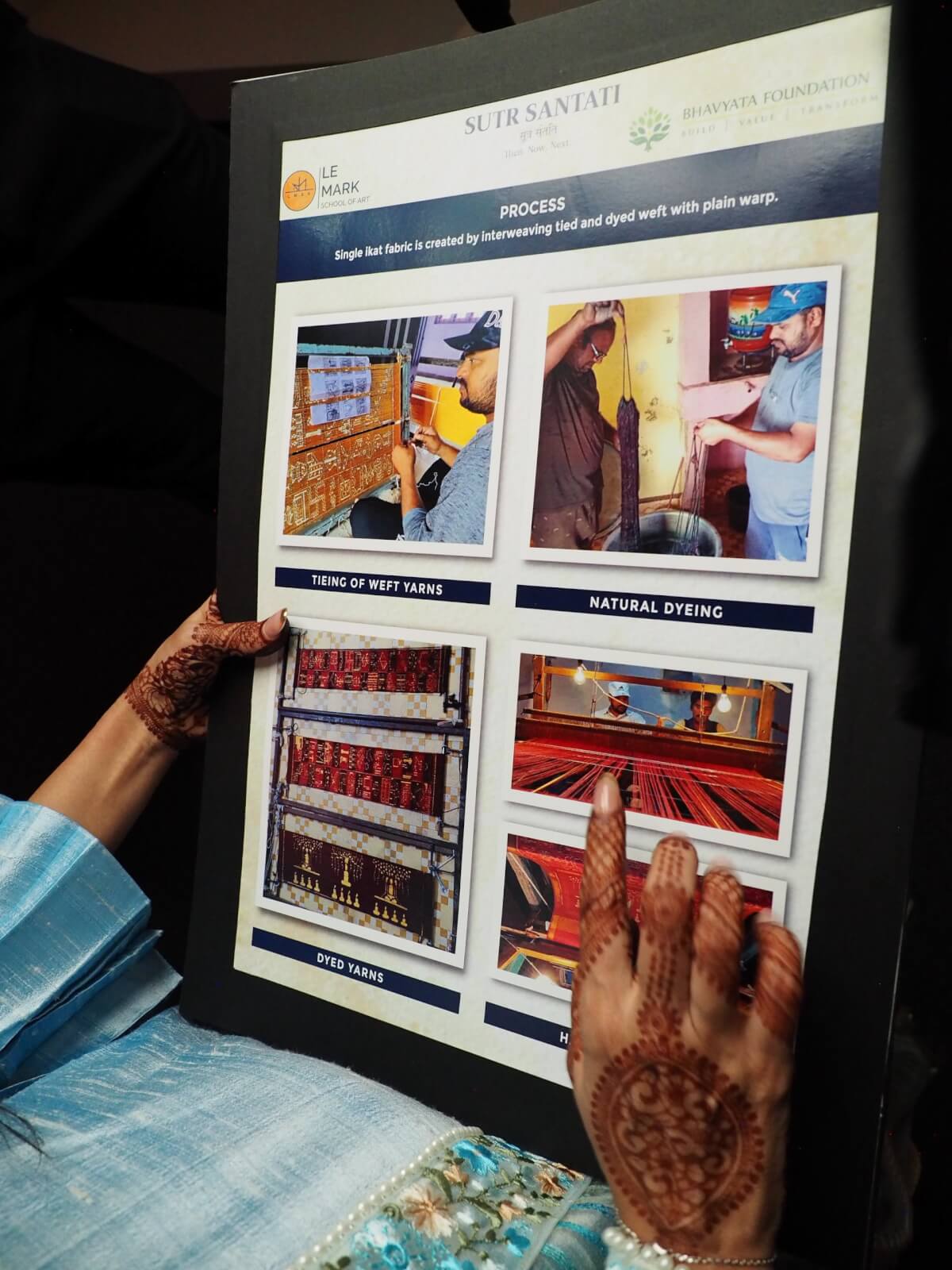
“It is important to keep these stories and techniques alive, to teach them,” she says. It’s apt one of her signature pieces in the exhibition is called guru’s treasure, because her wisdom as a guru to her students comes across in the depth of her art and the fervour of her communication.
Lavina Baldota: Generational Messages of Preservation
Lavina Baldota is the visionary curator of Sutr Santati. With over 20 years of experience in textiles, she still found she had a lot of learning to do to bring together the 75 specially commissioned pieces for this exhibition.
“I wanted to show the design language of India to a global audience. It’s a language that’s quite contemporary.”
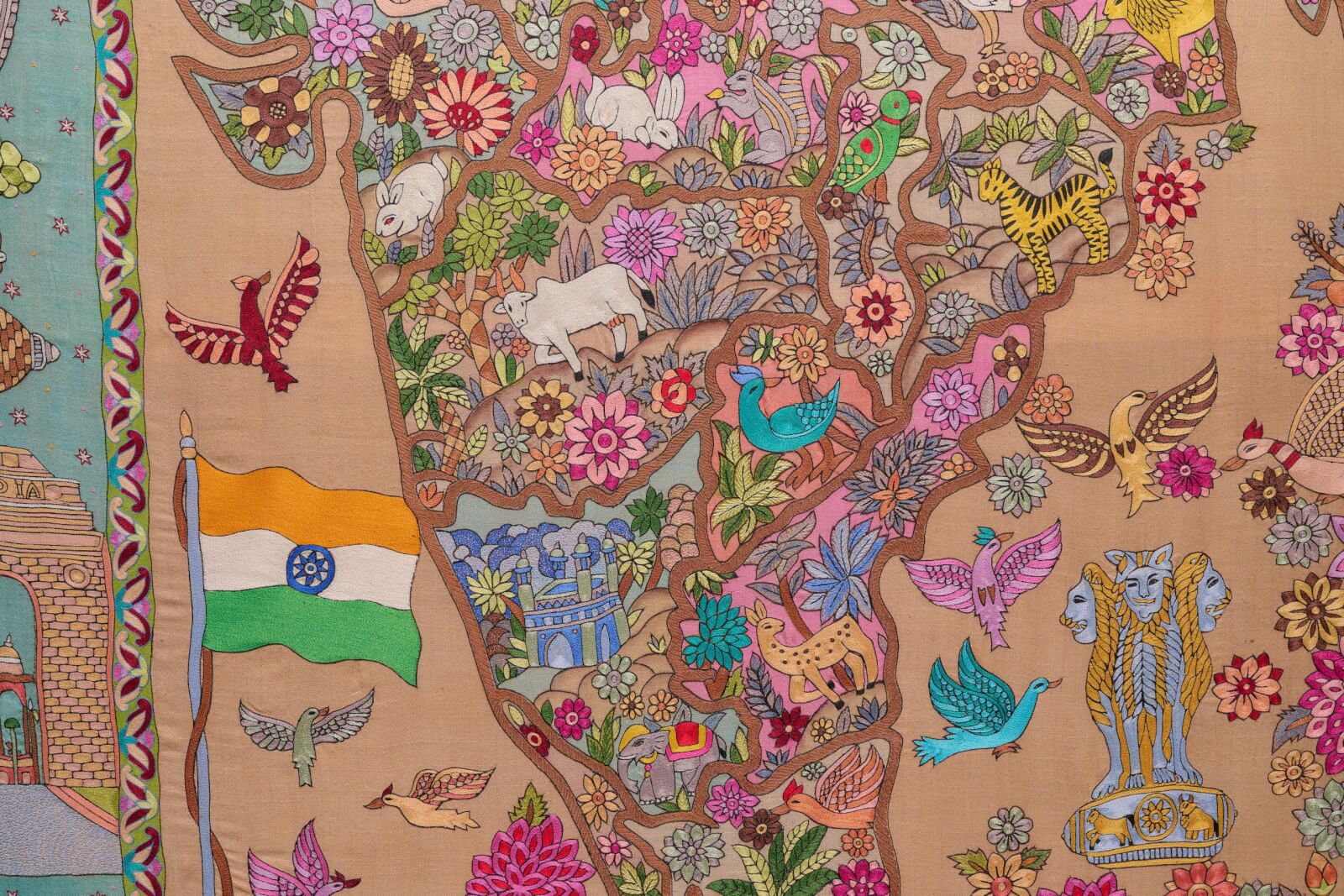
The exhibition seeks to showcase a sense of Indianness, drawing on past traditions and an optimistic view of the future. For Lavina, Indianness melds innovation and excellence.
“Indianness is about being flexible, fluid, and adapting to the future. We are inspired by the past, but creating for the future, creating something par excellence showing the richness of our craft heritage, leaving a legacy for ourselves, future artists and couture houses alike.”
Lavina describes the process of creating the exhibition as ‘a very humbling experience.’
“I have known textiles, but the deeper I dived the the more aware I became of the vastness of the subject. I learned about new and lost techniques. I learned so much about the lives of artisans, their struggles, their future.”
“Santati, personally for me has been a limitless canvas of introspection and self-discovery, Woven by yarns of ethos derived from Gandhian influence, rendered with the hues of my most intrinsic emotions, especially love and pride for my roots, my country, its leaders, artists, artisans, aesthetics and its rich heritage.”
“I learned more than I ever knew about the process of natural dyeing, the coompliexities of the weaving, the technical details like the width of the loom, and the languishing crafts that need to be revived."
“I come from a family which upholds Gandhian principles and values as their way of life. My grandparents only wore khadi - handspun, handwoven cloth and saris. We stayed away from Bollywood styles.”
“My mother Ms Kanchan Daga is here. She has been my greatest influence. Even after growing up, I still rummage through my mother’s cupboard and enjoy her beautiful saris.”
In her work on this exhibition, Lavina focused on incorporating learning and messages for the next generation.
“Young people are the most important part of the future,” Lavina says.
“The Abheraj Baldota Foundation where I work supported apprenticeship students from three design institutes to work with master artisans, resulting in exception textile artworks."
“I know many young people are facing challenges in their mental health. I strongly believe a creative space can take them away from their worries. There is no dearth of traditional creative arts they can indulge in so they can understand, appreciate and aspire for their own culture.”
“This exhibition is about an awareness of what we have, which will create appreciation and then help those young artists to aspire to more.”
"Even while several historical traditions may be observed to be on the decline, practitioners are finding ways to reinvent them. In other cases, one sees remarkable means of disruption, helping emerge entirely new forms and creative approaches."
“This exhibition is also about inclusivity and sustainability. We highlight indigenous people’s stories and techniques in our textiles. Some of those people are very modest but have so much wisdom to transmit. Craft and culture are strongly interlinked. If we lose our craft, we lose the culture at the heart of our society. ”
In her advice to upcoming artists, Lavina says “every artist in this exhibition took a challenge to push a boundary. I encourage young artists to do the same.”
For Sutr Santati’s first time out of India, Lavina believes there are important resonances for the South Asians in Australia.
“For the diaspora, I encourage you to value your craft, to be proud of where you come from and where you are, and to understand the process that goes into something handmade.”

Image: Artists Abhishek Ganesh, Paresh Patel, Samira Shah, Lavina Baldota, Purvi Dosh, Gaurang Shah, and Manish Saksena at Sutr Santati launch in Melbourne.
With an eye to sustainability, Lavina made sure this exhibition’s works used eco-friendly dyes and incorporated ecological preservation. But alongside Sutr Santati’s core value of sustainability are the values of preservation and timelessness of craft, which resist the speed of today’s consumption culture.
Lavina recommends avoiding overindulgence in fast fashion.
For Lavina, fast fashion promotes disconnection from both how our clothes are made and the process of creating clothing, a process that starts with harvest from the earth and works through a chain of hands and effort before reaching us in a shop.
Sutr Santati’s artisans call attention to our deep tradition of beautiful hand-woven textiles that last. These items are unique, and contain emotion in the way the fabric and yarn are dyed and sewn, and in the way the textiles can be passed on within families to create positive emotional threads across generations.
“I support slow consumerism where possible - buying one thing that can become an heirloom, a generational connection. I want people to understand that what’s good for the environment is good for the body and mind as well.”
Sutr Santati: Then.Now.Next is on at Melbourne Museum until 3 September 2023. All images are courtesy of Melbourne Museum.
Sandeep Varma is the Founder of SAARI Collective.