Hearing South Asian culture be described as ‘foreign’, ‘exotic’ or on the flip side ‘dirty’, ‘loud’ and ‘smelly’ has not been easy. There is something to be said about how the way in which colonial thought of the ‘weird exotic Other’ shaped most of my childhood interactions with my Indian culture. As a child, witnessing my mother and visiting relatives receive side glances filled with pity or raised eyebrows and pursed lips at the beautiful patterns and colours that strayed from the ‘acceptable’ hues of beige, white, black and other neutrals, taught me that I didn’t want to be one being glanced at. I know I’m not alone when I say that growing up, I was ashamed of wearing desi clothing. It made my brown skin appear browner, the thickness of my brows appear thicker ,and somehow made me feel like the spices from my mother’s kitchen clung to my skin.
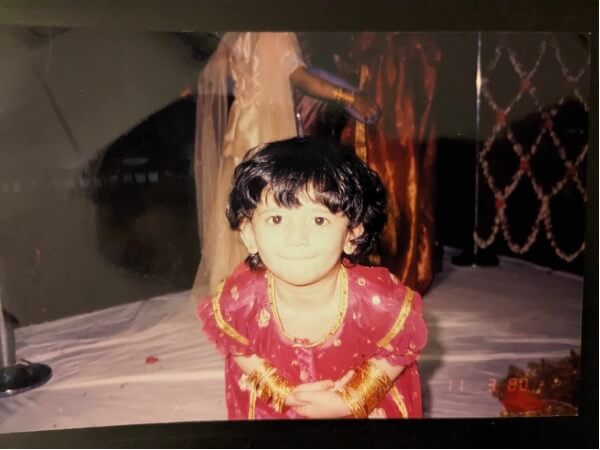
I began my childhood loving South Asian clothing but it was somewhere between migrating to Australia and 2016 that I gave in to Eurocentric ideals of 'normal' and 'professional'.
It was only when I took the leap during my final year of high school and wore my mum’s red and black shalwar kameez to a friend’s birthday celebration being held at a fancy restaurant in Sydney’s CBD that I began my journey of healing my contentious relationship with the Indian part of myself. I distinctly remember boarding the train at Clyde, nervously fiddling with my shoulder bag and glancing around every two seconds anticipating looks of pity and raised eyebrows.
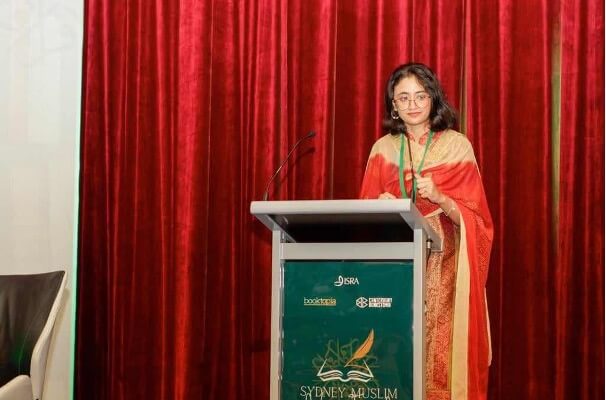
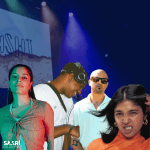
Lina wearing a shalwar kameez as an MC at the Inaugural Sydney Muslim Writers' Festival in 2022 at Bankstown, Sydney.
The moment that changed everything came somewhere between Homebush and Redfern when the fiddling stopped, my shoulders relaxed and my attention was no longer on the people around me but rather on appreciating how breathable the cotton was on that sweltering summer day. As movie-like as it sounds, in the span of about 40 minutes, I had gone from constantly looking over my shoulder and wondering how I could rid myself of (what I then incorrectly believed to be) the turmeric stain of my ancestors to feeling emboldened, comfy, and fuzzy.
Over the years, that feeling of fuzziness has only grown stronger - it now thrives as a ball of confidence, colonial defiance and deep-seeded love and appreciation for desi clothing. I have not looked back since.
Five years on, I’ve finally thought about this enough to want to write about it. It helps that Australian politicians such as Greens Senator Mehreen Faruqi wear desi clothing when sitting in parliament, when she’s advocating on the streets, and at formal events for the rights of the marginalised and vulnerable.
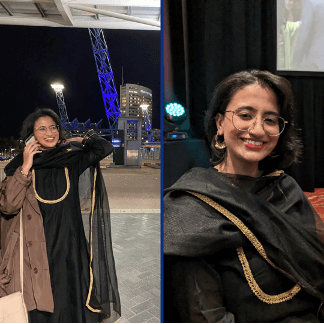
Lina at Western Sydney Community Forum's Zest Awards 2023 where she was nominated for 'Outstanding Youth Leader'.
What began for me as a personal determination to love and appreciate my Indian roots has now become a full-blown reflection on how the limited and stereotypical understanding of non-Western cultures coupled with the elevation of Western customs, beliefs and clothing as superior is, pardon my French, a load of shit.
Western knowledge of South Asian cultures confines the wearing of our colourful traditional clothing to either multicultural events at schools and workplaces or extravagant affairs. Wherever one may look in South Asia, the wearing of sarees and shalwar kameez is not confined to parties, cultural events, or special occasions.
While brides, bridal parties, and wedding guests do wear glamorous versions of sarees and shalwar kameez to their events, a little bit of research shows that past prime ministers (i.e. Indira Gandhi) and current parliamentary representatives, teachers, principals, medical professionals, judges, lawyers, CEOS and the list goes on, wear sarees and shalwar kameez in their daily lives, their professional lives and when they’re getting lit. Sarees and shalwar kameez, two of the most beautiful and common desi attires worn by females are understood in the Western world to be fabrics of an exotic nature.
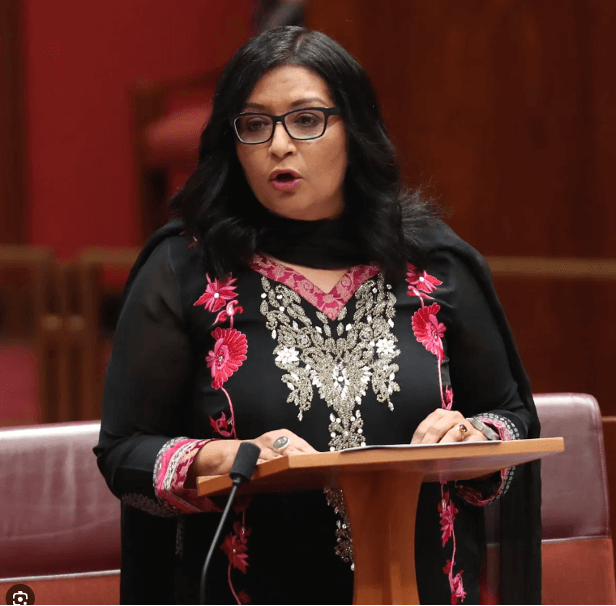
Senator Mehreen Faruqi speaking at the Australian Parliament.
Once again, we see non-western cultures being forced to exist within binaries; 1) Formal Western clothing i.e. cocktail and evening dresses and suits are formal whereas non-western formal clothing is not professional enough, 2) Non-western clothing is either for the poor and/or oppressed masses or it’s worn as a part of an extravagant, one-off event. The point is: they’re not for us - us being anyone who has decided to come and live in the Western world.
Now some may argue that there has never been an outright indication that South Asian clothing is weird or not welcome in professional settings. I argue that even behaving as if we’re a spectacular new species just brought in from the cold is just as powerful in its ability to make us think twice before deciding to wear sarees.
When a compliment is given to someone wearing a nice cocktail or evening dress, it sounds something like this “I love what you’re wearing [insert what you love about the dress and maybe if you really like it, ask where you too can buy it from].” But this compliment is rarely ever accompanied by fondling the material on the person’s outfit or throwing in words such as ‘princess’, or ‘exotic’. I can tell you that 8 out of 10 times when I wear South Asian attire, people feel free to touch my clothing as if I’m a mannequin in a store modelling an outfit they are interested in buying.
It’s insulting and makes me [and I’ve heard from other South Asian friends and colleagues] highly uncomfortable. Some people may question: but why? Isn’t being compared to looking like a ‘princess’ or called ‘exotic’ a compliment? Shouldn’t knowing that people will go out of their way to come and touch the fabric of my cultural dress be considered signs of envy and praise?
While I understand the sentiment of being dazzled by something foreign to one’s worldview, myself and many South Asian women find it difficult to reconcile being dazzled and appreciative of someone else’s culture with just plain physical boundary invasion.
When I wear a saree or a shalwar kameez, I am paying homage to the South Asian women who have defied odds before me. My intention is not to become a mannequin spectacle for view in the middle of the room, reduced once again to nothing but the exoticness of my appearance and physical traits.
Sarees, shalwar kameez, anarkali, sharara, ghaghra - the list is endless. As a grown woman I would not trade any of these clothes for the sake of fitting nicely into the Eurocentric standard of ‘polished’, ‘classy’ or ‘professional’. The blood that runs in my veins is that of women who have and continue to toil for their rights, fight the sickly sweet facade of Western liberalisation, and stick a finger up to the patriarchy; and just like them, I aim to continue their fight and do it all while wearing the colours, patterns and cuts in which they loved, fought, failed and succeeded in.
Lina Ali is a Muslim Indian-Australian writer from Sydney, NSW. She currently works for Media Diversity Australia and is doing her English honours thesis on the legacy of colonialism in the ongoing and evolving Hindu-Muslim riots that span the South Asian continent.You can connect with her via Linkedin and on Instagram (@_lrali).